Lectures at Conferences - Good or Bad?
There has been an fascinating debate on the role of lectures in conferences recently on twitter. What makes this particularly interesting is that those involved in the debate are all proponents of active learning for students. They all agree that there is overwhelming evidence that active learning leads to better learning, and many use active learning techniques in their lectures. But the group was split over how this should or shouldn't be applied to conferences.
Broadly speaking there were those who thought that active learning principles should apply to conferences too – in other words that a conference is a learning event and that research presentations at conferences should involve some form of discussion or audience participation.
On the other side, there were those who argued that a conference is very different to the learning situation of our undergraduate students, that a lecture is a very good way of transferring information (which is the aim of a conference), that people at conferences are experts and therefore different rules apply and that audience participation does not work at a conference, particularly one attended by scientists! Michael Seery expands on these points in his blog post.
I agree with much of what Michael says although perhaps for different reasons. Lectures can be exciting, entertaining, and informative and are therefore valuable. A lecture is not necessarily an entirely passive experience – a well constructed lecture that aims to engage the audience, that is targeted at the correct level can result in the audience actively constructing knowledge – a goal of all constructivist teachers! But this is true of all learning contexts. Undergraduate lectures that use active learning pedagogies still contain periods in which the lecturer is simply talking. Indeed with approaches such as Peer Instruction, mini-lectures and lecturer explanations are explicitly part of the pedagogy. However, although I think lectures have an important role, the evidence shows that greater depth of understanding is achieved when at least some of the time is spent being actively engaged in the learning such as through discussing/problem solving.
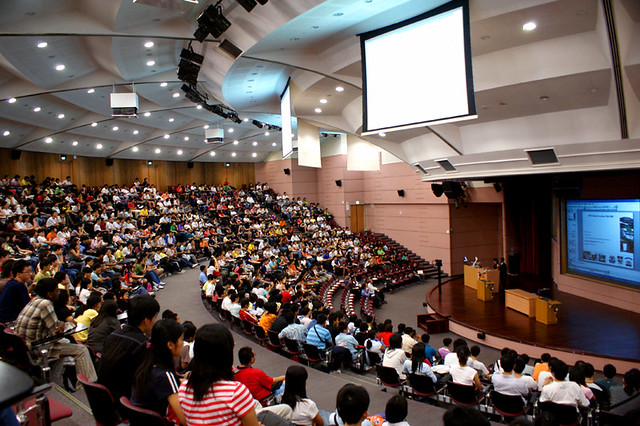
That doesn't of course mean that approaches such as Peer Instruction should be used in conferences (in most cases they shouldn't). I imagine a conference talk where the speaker asks the audience to discuss an issue amongst themselves is not going to work in most contexts. But I also think that we should be more ambitious and more demanding of conferences. Is it really the most efficient use of our time to sit in hour after hour of (often very poor) presentations on the off chance that one will provide a nugget of gold? Is transfer of information really the most that we expect to gain from conferences? True, we may learn something useful from the presentations, but often it is the chats over coffee or in the pub that are the most valuable, and yet these are often far too short!
I think we can apply Bloom's taxonomy here. A lecture may result in us learning new facts, or gaining new understanding about a particular idea, but it does not generally lead to us analysing, or evaluating the research. This is as true of attendance at conferences as it is for student in the lecture hall. Maybe that's all we want. But one of the best conferences I've ever been to was a conference on optical sensors in Spain. Other than a few plenary lectures, there were no talks. Rather, all participants presented posters. During a poster session we either stood by our poster and had discussions with those most interested in our work, or we walked round and talked to other presenters about their research. We were then split into groups of around 15-20 and we discussed the posters we had seen. We talked about the different approaches used, we analysed the benefits, the difficulties, the implications of the results, we evaluated the research and eventually a few were picked out for special mention at a later plenary. This type of conference is unusual, but creates opportunities for much more detailed conversations than a typical day of lectures. It results in more active engagement with the research, but also offers the chance to be more focussed – to pick out the research most likely to be relevant or of interest.
So, I certainly think that lectures have their place in conferences, just as lecturer explanations have a place in undergraduate teaching. But I also think conferences don't need to be about only sitting through a day of lectures and that by using different approaches we can create opportunities for more in depth discussions which will enhance our own research as well as that of our fellow scientists.

Lectures at Conferences- Good or Bad? by Anna Wood is licensed under a Creative Commons Attribution-NonCommercial-ShareAlike 3.0 Unported License.
Broadly speaking there were those who thought that active learning principles should apply to conferences too – in other words that a conference is a learning event and that research presentations at conferences should involve some form of discussion or audience participation.
On the other side, there were those who argued that a conference is very different to the learning situation of our undergraduate students, that a lecture is a very good way of transferring information (which is the aim of a conference), that people at conferences are experts and therefore different rules apply and that audience participation does not work at a conference, particularly one attended by scientists! Michael Seery expands on these points in his blog post.
I agree with much of what Michael says although perhaps for different reasons. Lectures can be exciting, entertaining, and informative and are therefore valuable. A lecture is not necessarily an entirely passive experience – a well constructed lecture that aims to engage the audience, that is targeted at the correct level can result in the audience actively constructing knowledge – a goal of all constructivist teachers! But this is true of all learning contexts. Undergraduate lectures that use active learning pedagogies still contain periods in which the lecturer is simply talking. Indeed with approaches such as Peer Instruction, mini-lectures and lecturer explanations are explicitly part of the pedagogy. However, although I think lectures have an important role, the evidence shows that greater depth of understanding is achieved when at least some of the time is spent being actively engaged in the learning such as through discussing/problem solving.
That doesn't of course mean that approaches such as Peer Instruction should be used in conferences (in most cases they shouldn't). I imagine a conference talk where the speaker asks the audience to discuss an issue amongst themselves is not going to work in most contexts. But I also think that we should be more ambitious and more demanding of conferences. Is it really the most efficient use of our time to sit in hour after hour of (often very poor) presentations on the off chance that one will provide a nugget of gold? Is transfer of information really the most that we expect to gain from conferences? True, we may learn something useful from the presentations, but often it is the chats over coffee or in the pub that are the most valuable, and yet these are often far too short!
I think we can apply Bloom's taxonomy here. A lecture may result in us learning new facts, or gaining new understanding about a particular idea, but it does not generally lead to us analysing, or evaluating the research. This is as true of attendance at conferences as it is for student in the lecture hall. Maybe that's all we want. But one of the best conferences I've ever been to was a conference on optical sensors in Spain. Other than a few plenary lectures, there were no talks. Rather, all participants presented posters. During a poster session we either stood by our poster and had discussions with those most interested in our work, or we walked round and talked to other presenters about their research. We were then split into groups of around 15-20 and we discussed the posters we had seen. We talked about the different approaches used, we analysed the benefits, the difficulties, the implications of the results, we evaluated the research and eventually a few were picked out for special mention at a later plenary. This type of conference is unusual, but creates opportunities for much more detailed conversations than a typical day of lectures. It results in more active engagement with the research, but also offers the chance to be more focussed – to pick out the research most likely to be relevant or of interest.
So, I certainly think that lectures have their place in conferences, just as lecturer explanations have a place in undergraduate teaching. But I also think conferences don't need to be about only sitting through a day of lectures and that by using different approaches we can create opportunities for more in depth discussions which will enhance our own research as well as that of our fellow scientists.
Lectures at Conferences- Good or Bad? by Anna Wood is licensed under a Creative Commons Attribution-NonCommercial-ShareAlike 3.0 Unported License.

Comments
Post a Comment
Ask me anything here...