Physics Wallah Class 10 Science Notes
Class 10 important question for board 2021-2022
Science Notes for class 10

Class 10 Science Notes | CBSE Class 10 Revision Notes
Notes for Class 10 Science Chapter-wise
Latest* Check Here Important
Science Notes for class 10
Latest* Check Here Important
Science Notes for class 10
Revision Notes on Chemical Reactions and Equations
Chemical Reactions and Equations
Any process that involves the rearrangement of structure of the substance or conversion of reactants into products is defined as Chemical Reaction.
For a Chemical Reaction to occur, the change can be observed in the form of -
Change in State: Melting of ice into water.
Change in Colour: Iron rusting which has colour change from silver to reddish brown.
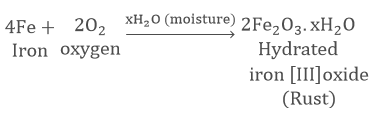
Change in Temperature: There are two types of reaction i.e Exothermic and Endothermic Reaction.
Exothermic Reactions: Those reactions in which energy is released in the form of heat are called Exothermic Reactions.
Examples -
(1) All combustion reactions e.g.
CH4+ 2O2 —> CO2 + 2H2O + Heat
(2) Thermite reactions e.g.
2A1 + Fe2O3 —> 2Fe + Al2O3 + Heat
Combinations are generally exothermic in nature. The decomposition of organic matters into compost is an example of exothermic reaction.
Endothermic Reactions: Those reactions in which energy is absorbed are called Endothermic Reactions.
Examples -
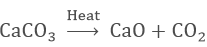
also, the reaction of photosynthesis -

Evolution of any gas: When Zinc reacts with sulphuric acid it gives hydrogen gas.
Zn + H2 SO4 → ZnSO4 + H2
Formation of Precipitate: When a soluble carbonate reacts with Barium, Barium Carbonate precipitate can be observed.
Change in State
Some chemical reactions are characterized by a change in state.
When wax is burned (in the form of wax candle,) then water and carbon dioxide are formed.
Now, wax is a liquid whereas carbon dioxide is a gas. This means that during the combustion reaction of wax, the physical state changes from solid to liquid and gas.
Physical Change
In this change identity of the substance remains same.
For Example, Melting, Boiling etc.
Chemical Change
The identity of the substances change
Reactants are converted into substance due to formation or broken down of older bonds
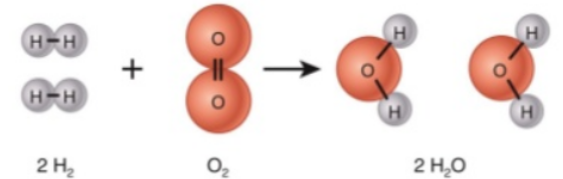
Chemical Equation
The symbolic representation of chemical reaction using symbols and formulae is known as Chemical Equation. For this, reactants are written in left hand side whereas products are written on the right.
Balanced Chemical Equation
A balanced chemical equation is the one where the number of atoms involved in reactants side is equal to number of atoms on product side.

Eq.1. Example of Balanced Chemical Equation
Steps to form Balanced Equation
To show how to balance the equation, the following equation is used-
Fe + H2O → Fe3O4 + H2
Step 1: First of all, draw the boxes around each formula as shown below-

Step 2: Find out the number of atoms of each element. For Example, on reactant side, 1 for Fe, 2 H, and 1 O and on product side we have, 3 for Fe, 4 for O and 2 for H.
Step 3: Start to balance the equation with the compound having maximum number of atoms. While balancing does not alter the formula of the compound.
Step 4: One by one balance each element on reactant and product side.

Step 5: After balancing number of atoms on both the side of the equation, finally check the correctness of the balanced equation.

Step 6: then write the symbols of the physical state of reactants and products as shown below-
3Fe(s) + 4H2O (g) → Fe3O4 (s) + 4H2 (g)
This above equation represents the balanced equation.
Balancing a Redox Reaction
The basic ionic form of the equation is-
Fe2+ + Cr2O72- → Fe3+ + Cr3+
Oxidation half reaction is-
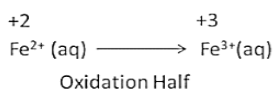
Reduction half reaction is-
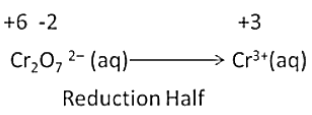
Use the reduction half method to balance the equation. Balance the atoms in each half of the reaction except H and O atoms.
Cr2O72- (aq) → 2 Cr3+(aq)
Add water molecules as the reaction is taking place in acidic solution. This is to balance the O atoms and hydrogen ions.
Cr2O72- (aq) + 14 H+(aq) → 2 Cr3+(aq) + 7H2O (I)
Then balance the charges in both half reactions.
Fe2+(aq) → Fe3+(aq) + e-
Cr2O72- (aq) + 14 H+ + 6e- → 2 Cr3+ + 7H2O
6 Fe2+(aq) → 6 Fe3+(aq) + 6e-
Two half of the equations are added to get the overall reaction
6Fe2+(aq) + Cr2O72-(aq) + 14H+(aq) → 6Fe3+(aq) + 2Cr3+(aq) + 7H2O (I)
Types of Chemical Reaction
Combination Reaction is reaction when single product is formed from the combination of two or more reactants. For Example-

Eq.2. Example of Combination Reaction
Reactions can be exothermic as well as endothermic. Exothermic reaction release heats and raises the temperature of the surroundings. For Example, Respiration is an example of exothermic reaction.

Eq.3. Example of Exothermic Reaction
Endothermic reaction involved the absorption of the heat and thus it cools the surrounding. The decomposition of dead organic material is an endothermic reaction.
Decomposition Reaction is type of reaction which involves breakdown of single reactant into simpler products. Decomposition of silver chloride into silver and chlorine in presence of sunlight is an example of decomposition reaction.

Eq.4. Example of Decomposition Reaction
- Displacement Reaction is a reaction in which more reactive element will displaces the less reactive element.

Eq. 5. Example of Displacement Reaction
Double Displacement Reaction is a type of reaction in which cations and anions in the reactants switch the places to form new products.

Eq. 6. Example of Double Displacement Reaction
Redox Reaction is also known as Oxidation-reduction Reaction. In this type of reaction transfer of electrons occurs between the two species. Oxidation is defined as addition of oxygen or removal of hydrogen. Reduction is defined as removal of oxygen or addition of hydrogen. Oxidizing agent is the one which gains the electrons and is reduced in a chemical reaction. Reducing agent is oxidized in a chemical reaction and it loses the electrons. Fluorine is the strongest oxidizing agent. Formic acid is a reducing agent

Eq.7. Example of Redox Reaction
Corrosion
Metals are prone to corrosion. It is a slow conversion of metals into some undesirable compounds. This occur may be due to reaction with oxygen, gases, acids etc. When irons reacts with atmospheric oxygen and moisture, a red layer is formed on the surface of the iron, this process is known as Rusting.
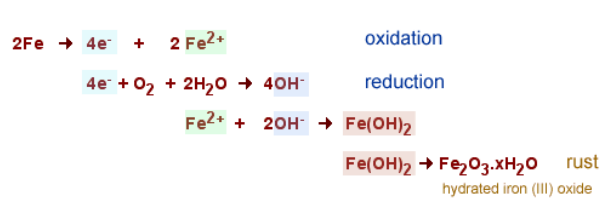
Eq. 8. Equation for Iron Rusting
Rancidity
When food containing fats and oils are exposed to the atmosphere, the oxidation of fat and oil occurs, this is known as Rancidity.
Methods to Prevent Rancidity
Store cooking oils from direct sunlight.
Food should be placed at low temperature.
By adding antioxidants food can be protected from rancidity.
Packing material should replace the air with nitrogen.
Minimize the use of salts in fried foods
Science Notes for class 10
Revision Notes on Acids, Bases and Salts
The taste of the food is due to presence of acids and bases in them.
Acids
Acids is defined as the one which produces hydrogen ions in water. For Example, Sulphuric Acid, Hydrochloric Acid etc.
They give sour taste.
Acids turn blue litmus to red. This is used as confirmation test for the presence of acid.
When acids react with metals, gases are evolved.
Reactions with Acids
1. Reaction of Acid with Metal
Acid + Metal → Salt + Hydrogen gas
Mg + H2 SO4 → H2 + Mg SO4
2. Reaction of Acid with Carbonates
Na2 CO3 (s) + 2 HCl (aq) → 2NaCl (aq) + H2O(l) + CO2(g)
3. Reaction of Acid with Bicarbonates
NaHCO3 (s) + HCl (aq) → NaCl(aq) + H2O (l) + CO2 (g)
Similarity between Acids and Bases
Both acids and base react with water. They produce ions in water
Both acids and bases acts as electrolytes, so are good conductors of electricity.
Both of them changes the colour of the litmus paper.
Classification of Acids
Acids are classified as Organic Acids and Mineral Acids. Acids which are derived from plants and animals, they are known as Organic Acids. For Example, Citric Acid from fruit. Mineral acids are inorganic acids such as Sulphuric Acid. They are dangerous to be used, so need more precautions.
Acids are also classified as Strong Acids or Weak Acids. Strong acid is an acid, that completely dissociates into ions in aqueous solutions. For Example, Sulphuric Acid, Hydrochloric Acid.

Weak acid is the one which does not dissociate completely into ions in aqueous solutions. For Example, Acetic Acid.

Acids can also be as Dilute Acid and Concentrated Acids. The one which has low concentration of acids in aqueous solution, they are known as Dilute Acids whereas the one which has high concentration of acids in aqueous solution, are known as Concentrated Acids.
It is advisable to add acid to water and not vice versa because large amount of heat is released if water is added to acid. This released heat is large enough to cause harm.
Acids can also be classified based on number of hydrogen ions. Monoprotic acid is the one which gives one mole of hydrogen ions per mole of acid, such as HCl. Diprotic Acid is the one which produces two mole of hydrogen ions per mole of acid. For Example, H2SO4.
Bases
Bases are the one which produces hydroxide ions in aqueous solutions. Bases which are water soluble they are known as Alkalis.
They turn red litmus to blue.
They have a bitter taste.
They also produced carbon-dioxide when reacted with carbonates.
They also evolved hydrogen gas when bases react with metals.
Reactions of Bases
1. Reaction with Metals
Base reacts with metals and produce hydrogen gas.
2NaOH + Zn → Na2 → Na2ZnO2 + H2
2. Reaction with Acids
Base reacts with acids to form salts. For Example,
KOH + HCl → KCl + H2O
3. Reaction with Non-metallic Oxides
Base reacts with non-metallic oxides to form salt and water.
2NaOH + CO2 → CO2 → Na2CO3 + H2O
Classification of Bases
Bases are classified as Strong Base and Weak Base. Strong base is the one which dissociates completely into its ions in aqueous solution. For Example, NaOH.
Weak base is the one which does not dissociate completely into its ions in aqueous solutions. For Example, Ammonium Hydroxide, NH4OH
Bases are also classified as Dilute Base and Concentrated Base. The solution which has low concentration of base in aqueous solution is defined as Dilute Base whereas the one which has high concentration of base in aqueous solution is known as Concentrated Base.
Strength of Acid or Base Solutions
The dissociation constant of weak acid or weak base can be represented as-

Suppose HA is weak acid, then dissociation constant is represented as-

Strength of an acid or base can be determined using a pH scale. It is a scale to measure the hydrogen ion concentration in a solution. The p stands for ‘potenz’, it is a German word which means power.
If pH is equal to 7, means the solution is neutral.
If pH is greater then 7 means alkaline solution.
If pH is less then 7 means the solution is acidic.

Fig.1. pH scale
Importance of pH
Human body works at a pH of about 7.4.
Stomach has a pH of about 2 due to presence of hydrochloric acid in it. It is needed for the activation of pepsin protein required for protein digestion.
When we eat food containing sugar, then the bacteria present in our mouth break down the sugar to form acids. This acid lowers the pH in the mouth. Tooth decay starts when the pH of acid formed in the mouth falls below 5.5. This is because then the acid becomes strong enough to attack the enamel of our teeth and corrode it. This sets in tooth decay. The best way to prevent tooth decay is to clean the mouth thoroughly after eating food.
Many animals and plants protect themselves from enemies by injecting painful and irritating acids and bases into their skin.
When honey bee stings a person, it injects an acidic liquid into the skin. Rubbing with mild base like baking soda solution on the stung area of the skin gives relief.
When a wasp stings, it injects an alkaline liquid into the skin. Then rubbing with a mild acid like vinegar on the stung area of the skin gives relief.
Soil pH and plant growth: Most of the plants grow best when the pH of the soil is close to 7. If the soil is too acidic or basic, the plants grow badly or do not grow at all. The soil pH is also affected by the use of chemical fertilisers in the field. Chemicals can be added to soil to adjust its pH and make it suitable for growing plants. If the soil is too acidic then it is treated with materials like quicklime or slaked lime. If the soil is too alkaline then alkalinity can be reduced by adding decaying organic matter.
Salts
When acid and base neutralize, salts are formed. Strong acid and strong base combines to form neutral salt.
NaOH + HCl → NaCl + H2O
Eq.1. Formation of Neutral Salt
Strong acid and weak base combine to form acidic salt. For Example, Hydrochloric Acid and ammonium hydroxide combine to form ammonium chloride. Other examples, sodium hydrogen carbonate, sodium hydrogen sulphate etc.
HCl + NH4OH → NH4Cl + H2O
Eq.2. Formation of Acidic Salt
Similarly, weak acid and strong base combine to form basic salt. For Example, Acetic Acid and sodium hydroxide combine to form sodium acetate. Other examples are calcium carbonate, potassium cyanide etc.
CH3COOH + NaOH → CH3COONa + H2O
Eq.3. Formation of Basic Salt
The most common salt is table salt or sodium chloride (NaCl).
Indicators
They are the substances that which indicate acidic or basic nature of the solution using colour change. For Example, litmus solution, methyl orange, phenolphthalein, methyl red etc. Acids convert blue litmus paper red in colour. Bases turn red litmus blue. Phenolphthalein remains colourless in presence of acids but turn pink in presence of bases.
Some Important Chemical Compounds and their uses
Science Notes for class 10
Revision Notes on Metals and Non-metals
Elements are classified as metals and non-metals based on different properties. The properties of metals and non-metals are given in the form of table below-
Chemical Properties of Metals
Metals react with air or oxygen to form metal oxide.
For Example, Copper reacts with oxygen to form copper oxide.
Metal + O2 → Metal oxide
2Cu + O2 → 2CuO
4Al + 3O2 → 2Al2O3
Oxides of metals can react with both acids and bases to produce salt and water. Such oxides are known as Amphoteric Oxides.
Al2O3 + 6HCl → 2AlCl3 + H2O

Metals also reacts with water to form metal oxide. Metal oxide in turn can react with water to form metal hydroxide. For Example
2Na + 2H2O → 2NaOH + 1H2
2Al + 3H2O → Al2O3 + 3H2
Metals also reacts with dilute acids to form salt and hydrogen. For example, magnesium reacts with dilute hydrochloric acid to form magnesium chloride and hydrogen.
Metal + Acid → Metal Salt + Hydrogen
Mg + 2HCl → MgCl2 + H2
Chemical Properties of Non-metals
Non-metals reacts with oxygen to form non-metal oxide.
Non-metal + Oxygen → Non-metal oxide
C + O2 → CO2
Non-metals do not react with water and acids to evolve hydrogen gas.
Non-metals can react with salt solution; more reactive element will displace the less reactive non-metal.
2 NaBr (aq) + Cl2(aq) → 2NaCl (aq) + Br2 (aq)
Non-metals can also react with hydrogen to form hydrides.
H2(g) + S(l) → H2S(g)
Reactivity Series
The series in which metals are arranged in the decreasing order of reactivity, it is known as Reactivity Series.

Fig.1. Reactivity Series
Ionic Compounds
Compounds formed due to the transfer of electrons from a metal to a non-metal are known as Ionic Compounds.

Covalent Bond
Bond formed by sharing of electrons between the two atoms. They share their valence electrons to gain stability.

Properties of Ionic Compounds
They are generally hard and solid.
They have a high melting and boiling point.
They are soluble in water but insoluble in inorganic solvents such as ether etc.
They are conductors of electricity in molten and solution state.
Occurrence of Metals
Elements or compounds which occurs naturally in earth crust are known as Minerals. Minerals from which pure metals can be extracted are known as Mineral Ores.

Extraction of pure metals from its ores/steps for extraction of metals from its ore
The first step is enrichment of the ore.
Second step includes extraction of metals
Third steps involve refining of metal
Gangue - Ores contain different impurities in it such as sand, soil etc. These impurities are known as Gangue.
Extracting Metals which are low in activity series
Metals which are low in activity series are unreactive. The oxides of such metals can be reduced to metals by heating alone. For Example, Cinnabar (HgS)

Extracting Metals in the middle of the Activity Series
These metals are moderately reactive. They exists as sulphides or carbonates in nature. Before reduction, metal sulphides and carbonates must be converted into metal oxides. Sulphide ores are converted into oxides by heating strongly in presence of excess air, this is known as Roasting. Carbonate ores are converted into oxides by heating in limited air. This is known as Calcination.
Roasting

Calcination

Reduction-metal oxides can be reduced to metals using reducing agent such as such as Carbon.
Extracting metals towards the top of the activity series
The metals are highly reactive. They cannot be obtained by heating. For Example, Sodium, magnesium and calcium are obtained by the electrolysis of their molten chlorides.
At cathode Na+ + e- → Na
At anode 2Cl- → Cl2 + 2e-
Refining of Metals
Refining of impure metal is done using electrolytic refining. Impure copper is used as anode and strip of pure copper is used as Cathode. Acidified copper sulphate is used as electrolyte. When electric current is passed through this, impure metal from the anode gets deposited in the electrolyte solution, whereas pure metal from the electrolyte is deposited at cathode.
Deposition of insoluble residue formed from the dissolution of anode during commercial electrolysis.

Fig.2. Electrolytic refining
Corrosion
Metals when exposed to moist air for a long period of time, they become corroded. This is known as Corrosion. For Example, Silver reacts with moist air and becomes black in colour due to silver sulphide coating.
Iron + oxygen → Iron (III) oxide
Fe + O 2 → Fe2O3
Prevention of Corrosion
Rusting of iron can be prevented by oiling, galvanizing, painting, greasing etc.
To protect steel and iron from rusting, a thin layer of zinc are coated on them, this is known as Galvanization.
Alloy
Mixture of two or more metals or metal and non-metal is known as Alloy. For Example,
Brass is an alloy of copper and zinc.
Bronze in an alloy of copper and tin.
Solder is an alloy of lead and tin.
Amalgam is one metal is mercury.
Science Notes for class 10
Revision Notes on Carbon and its Compounds
Two or more elements combine to form compound. There are two types of compounds- Organic Compound and Inorganic Compounds. Organic compounds are the one which are made up of carbon and hydrogen.
Covalent Bond
The bond formed by sharing a pair of electrons between two atoms are known as Covalent Bond. Carbon forms covalent bond. Carbon exists in two forms- as free state and as combined state. Free form of carbon is found in graphite, diamond and fullerene. In combined state, carbon exists as Carbon-dioxide, Glucose, Sugar etc.
Allotropes of Carbon
Different forms of an element that has same chemical properties but different physical properties are known as Allotropes. There are three allotropes of carbon- diamond, graphite and fullerene.
Diamond
Diamond exits as three-dimensional network with strong carbon-carbon covalent bonds. Diamond is hard in nature with high melting point. It shines in presence of light and it is a bad conductor of electricity. The most common use of diamond is in making jewellery. It is also used in cutting and drilling tools.
Graphite
Graphite is made from weak van der wall forces. Each carbon atom is bonded with other three carbon atoms in order to form hexagonal rings. It serves as good conductor of heat and electricity. It is used as dry lubricant for machine parts as well as it is used in lead pencils.
Fullerene
It is a hollow cage which exits in the form of sphere. Its structure is similar to fullerene. But along with hexagonal rings, sometimes pentagonal or heptagonal rings are also present.

Fig.1 Structure of fullerene
Two Important Properties of Carbon
Catenation and tetravalency are the two important properties of carbon. Catenation is a property of carbon by which carbon atoms can link one another via covalent bond and can form long chains, closed ring or branched chains etc. Carbon atoms can be linked by single, double or triple bonds. Carbon has a valency of 4 due to which it is known to have tetravalency. Due to this one carbon atom can bond with other 4 carbon atoms, with other atoms also such as Oxygen, Nitrogen etc.
Hydrocarbons
Compounds which are made up of carbon and hydrogen they are known as Hydrocarbons. There are two types of hydrocarbons found - Saturated Hydrocarbons and Unsaturated Hydrocarbons. Saturated Hydrocarbons consist of single bonds between the carbon atoms. For Example, Alkanes. Alkanes are saturated hydrocarbons represented by a formula, CnH2n+2.
Unsaturated Hydrocarbons are the one with double or triple bonds between the carbon atoms. For Example, Alkenes and Alkynes. Alkenes are represented as CnH2n whereas alkynes are represented as CnH2n-2. Some saturated hydrocarbons and unsaturated hydrocarbons are represented as -

Fig.2. Saturated hydrocarbons

Fig. 3. Unsaturated hydrocarbons
Structure of hydrocarbons can be represented in the form of electron dot structure as well as open structures as shown below-
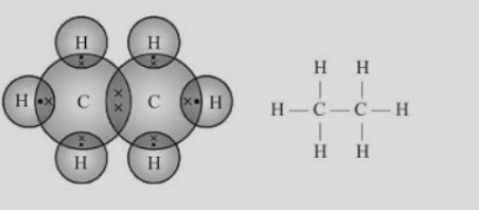
Fig.4. Electron dot structure and open structure of ethane

Fig.5. Electron dot structure and open structure of ethyne
Carbons Compounds based on the basis of structure
Carbon Compounds can be classified as straight chain compounds, branched chain compounds and cyclic compounds.They are represented as -

Fig.6. Straight chain carbon compound
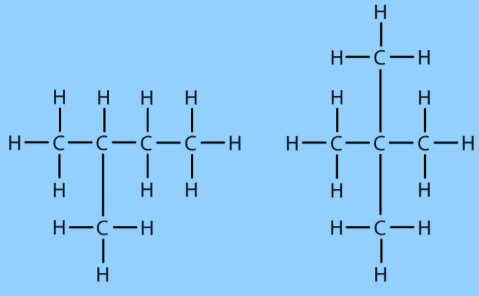
Fig.7. Branched chain compounds
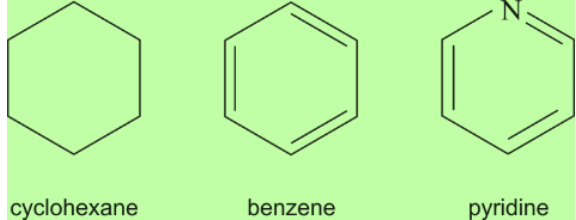
Fig.8. Cyclic carbon compounds
Functional Groups
One of the hydrogen atoms in hydrocarbon can be replaced by other atoms according to their valencies. The atoms which decides the properties of the carbon atoms, are known as Functional Groups. For Example, Cl, Br, -OH, Aldehyde, Ketone, Carboxylic Acid etc.
Homologous Series
Series of compounds in which same functional group substitutes for the hydrogen atom in a chain of carbon.

Fig.9. Homologous series
Nomenclature of Carbon Compounds
First of all, identify the number of carbon atoms in compounds. And in it identify the longest chain
Then functional group can be indicated by suffix or prefix.
Cyclic hydrocarbon is designated by prefix cyclo.
If there are two or more different substituents they are listed in alphabetical order
If the same substituent occurs more than once, the location of each point on which the substituent occurs is given

Fig.10. Different functional groups
Chemical Properties of Carbon Compounds
Combustion
Carbon along with its compound is used as a fuel as it burns in presence of oxygen to release energy. Saturated hydrocarbons produce blue and non-sooty flame whereas unsaturated hydrocarbons produce yellow sooty flame.
CH4 + 2O2 → CO2 + 2H2O
Oxidation
Alcohol can be oxidized to aldehydes whereas aldehydes in turn can be oxidized to carboxylic acid. Oxidizing agent such as potassium permanganate can be used for oxidation.

Addition Reaction
Hydrogenation of vegetable oil is an example of addition reaction. Addition of hydrogen in presence of catalyst such as nickel or palladium. This converts oil into ghee.

Substitution Reaction
When one atom in hydrocarbon is replaced by chlorine, bromine, etc. this is known as Substitution Reaction.

Important Carbon Compounds: Ethanol and Ethanoic Acid
Ethanol is a volatile liquid with low melting point. It reacts with sodium to form sodium ethoxide.

This above reaction is used to test the presence of ethanol by the evolution of hydrogen gas.
Dehydration of ethanol in presence of hot sulphuric acid forms alkene.

Ethanoic acid is a colourless liquid. When pure ethanoic acid freeze like ice, it is known as Glacial Acetic Acid. It is formed at a temperature of about 16.6 degree centigrade
Ethanoic Acid/Acetic acid when reacts with ethanol it forms an ester. Ester can be identified by its sweet smell.

Reaction of ester with strong base is used to form soap. This is known as Saponification. Acetic acid also reacts with strong base to form sodium acetate and water.
NaOH + CH3COOH + CH3COONa + H2O
Soaps and Detergents
Sodium or potassium salt of carboxylic acid is known as Soap. They work most effectively in soap water. Detergents are sulphonate or ammonium salt of long chain of carboxylic acid. They can work effectively on soft as well as hard water.
Cleansing Action of Soaps and Detergents
Cleansing action of soaps and detergents is due to ability to minimize the surface tension of water, to emulsify oil or grease and to hold them in a suspension of water. When soap dissolves in water, it forms soap anions and soap cations. The hydrophobic part of soaps and detergents are soluble in grease and hydrophilic part is soluble in water.
Soap and Micelle Formation
When dirt and grease are mixed with soap water, soap molecules arrange them in tiny clusters known as Micelle. The hydrophilic part sticks to the water and form outer surface of the micelle and hydrophobic part binds to oil and grease.

Revision Notes on Periodic Classification of Elements
Placing similar groups and species together is known as Classification. Classification is needed to easily understand the properties of different elements in a periodic table. Elements with similar properties are placed in one group to understand them easily.
Dobereiner’s triad consider three elements, in which atomic mass of central element is the arithmetic mean to two other elements. For Example, Atomic masses of lithium, sodium and potassium are 7, 23 and 39. The arithmetic mean of 7 and 39 gives 23. But disadvantage is the presence of only few triads.

Newland’s Law of Octave say that elements are arranged in such a way that every eight element has same properties as in the first element. According to him, only 56 elements are found which is a drawback of Newland Law of Octaves. This was not accepted. It is acceptable only upto calcium. He also placed some unlike elements in the same slot.

Mendeleev’s Periodic Table
Mendeleev used atomic masses as the basis of arrangement of elements. According to him, elements were arranged in increasing order of their atomic masses. It believes that there was a periodic reappearance in their physical and chemical properties.
Advantages of Mendeleev Periodic Table
He left gap for some undiscovered elements. For Example, Eka Boron etc.
This table also accommodate the noble gases
Also corrected the atomic masses of certain elements.
Limitations of Mendeleev Periodic Table
Position of isotopes cannot be explained
Position of hydrogen is not fixed. It is placed in group 1A, though its some properties matches with those of halogens.
Modern Periodic Table
D. Mendeleev discovered the modern periodic table in the year 1869. According to modern periodic law, “properties of an element are the periodic function of their increasing atomic number”.
Anomalies of Modern Periodic Table
Isotopes are placed at one place in the same group.
There is no element between hydrogen and helium as atomic masses always comes in whole numbers.
Atomic number is represented by Z, and it is equal to the number of protons in the nucleus of the atom.
It also consists of 18 vertical columns known as Groups and 7 horizontal rows known as Periods.
Elements having same number of valence electrons are placed in the same group.
As we go down in a group, number of shell increases.
Elements having same number of occupied shells are placed in same period.
Each period has a new electronic shell getting filled.
Number of elements placed in a particular period depends on the point how electrons are filled into various shell.
To find out the number of electrons in a shell, 2n2 formula can be used, where is n is shell number.
K Shell n = 1 or 2n2 = 2(1)2 = 2
L shell n = 2 or 2n2 = 2(2)2 = 8
Valence electron also determines the number of bonds which is formed by an element.
Trends in Modern Periodic Table
Valency and Valence Electrons - On moving left to right in a period, valency increases and then it decreases. But it remains same down in a group. As we move from left to right in a period, valence electron increases and remain same as we go down the group.
Atomic Size - It decreases left to right in a period as the nuclear charge increases due to large positive charges on the nucleus. Atomic size increases down in a group due to decrease in nuclear charges and addition of new shell.
Metallic Character - Ability of atom to lose the electron is known as Metallic Character. Metallic character decreases from left to right in a period. This is due to increase in nuclear charge. But non-metallic character increases left to right in a period. And metallic character increases down the group as the size increases it can easily lose electron.
Ionization Energy is the energy required to remove an electron from an isolated gaseous atom. Ionization energy increases as we move left to right in a period. This is due to increase in nuclear charge as we move left to right in a period. But down in a group ionization energy decreases due to decrease in nuclear charge but there are some exceptional cases.
Electropositive Character decreases from left to right in a periodic table and increases down the group. This is due to decrease in metallic character from left to right in a period.
Basic Character of Oxides increases down the group as atomic radius increases and ionization energy decreases. This is due to increase in metallic character or electro positivity of elements. Acidic character of oxides decreases as non-metallic character of elements decreases from top to bottom.

Fig 1. Trends in Periodic Table


Revision Notes on Life Processes
All the processes such as respiration, nutrition, circulation, excretion etc. that are necessary for the survival of the living organisms are known as life processes.
Modes of Nutrition
The two most common type of nutrition are autotrophic nutrition and heterotrophic nutrition.
Autotrophic Nutrition
It is a type of nutrition in which inorganic materials such as carbon-dioxide, is used up to synthesize organic food by a process known as photosynthesis. For example, green plants use autotrophic mode of nutrition. Organisms which uses autotrophic mode of nutrition are known as autotrophs.
Now the question arises how autotrophic nutrition occurs in plants using photosynthesis?
For the photosynthesis to occur, carbon-dioxide, water, sunlight and chlorophyll are the required raw materials. Sunlight provides energy, chlorophyll is used to absorb the sunlight, carbon-dioxide is reduced to carbohydrates and water is oxidized to release the oxygen. Water is taken up from the soil through the roots.
The site where the photosynthesis occurs in known as chloroplast. They contain green colour pigment known as chlorophyll that traps sunlight for photosynthesis.
Steps of the photosynthesis are as follows-
Absorption of light by chlorophyll.
Conversion of light energy into chemical energy.
Splitting of water into hydrogen and oxygen.
Finally, reduction of carbon-dioxide into carbohydrates.
Leaves contain small openings known as stomata which helps in exchange of gases. Stomata/stoma is surrounded by guard cell which guards the opening and closing of stomata. Guard cells also contain chloroplast.

Fig.1. Structure of Stomata
The overall equation of photosynthesis is:

Fig.2. Overall Equation of Photosynthesis
Heterotrophic Nutrition
In this mode of nutrition, an organism is unable to synthesize its own food. It is of following types-
1. Holozoic nutrition is a type of nutrition where an organism takes in whole food and break it inside the body. For example, Amoeba.
2. Saprophytic nutrition is a nutrition in which organisms feed on dead and decaying matter. For example, fungi.
3. Parasitic nutrition is a nutrition in which organism feed on living host. For example, Cuscutta.
Nutrition in Human Beings
Humans consists of alimentary canal which starts from mouth and ends at anus. The parts of the alimentary canal are as follows-
1. Mouth
2. Pharynx
3. Oesophagus/food pipe
4. Stomach
5. Small intestine
6. Large intestine
7. Rectum
8. Anus

Fig.3. Human Digestive System
Mouth is the first portion of the alimentary canal. mouth consists of muscular tongue and teeth’s. cavity inside the mouth is known as oral cavity.

Fig.4. Human Mouth Parts
Mechanism of Digestion of Food
Food digestion process begins in the mouth. Food is complex in nature.
To breakdown food and absorb it, we need biological catalyst known as enzymes.
Mouth contains salivary glands that secrete saliva. Saliva contains an important enzyme known as salivary enzymes that breaks down starch into simple sugars.
The food then passes via oesophagus into the stomach. The movement of the food inside the oesophagus occurs via rhythmic contraction of muscles, this is known as peristalsis.
Stomach contains gastric glands that secrete mucus, hydrochloric acid and pepsin. Pepsin is a protein digesting enzyme.
After stomach, food then enters into small intestine. Small intestine is larger in herbivores due to cellulose digestion compared to carnivores.
Complete digestion of carbohydrates, proteins and fats occurs in small intestine.
Small intestine receives secretions from pancreas and bile from the liver. Bile helps in emulsification of fats whereas pancreas secrete enzymes such as trypsin for protein digestion. Intestinal wall also contains glands that secrete intestinal juice.
Small intestine has villi that increases the surface area for the absorption of food.
The unabsorbed food is then transferred to large intestine where water is absorbed.
Undigested food is then expelled out from the anus.
Respiration
- It is a metabolic process which involves breakdown of food to release energy is known as respiration.

Fig.5. Breakdown of glucose by different pathways
The breakdown of pyruvate into ethanol and carbon-dioxide is absence of oxygen is known as fermentation. As this process occurs in absence of oxygen, it is known as anaerobic respiration. When the pyruvate is broken down in carbon-dioxide and water in presence of oxygen it is known as aerobic respiration.
The energy released during the process is used up to synthesize the ATP (adenosine triphosphate).
Compared to animals, plants used stomata to exchange carbon-dioxide and oxygen. This exchange occurs through diffusion.
Respiration in Human Beings
Human respiratory system starts consists of nostrils, nasal cavity, pharynx, trachea, bronchi, bronchioles and then lungs. In lungs, alveoli are present, where exchange between the oxygen and carbon-dioxide takes place.

Fig.6. Passage of air in Humans
Humans have a respiratory pigment known as haemoglobin to carry the oxygen to different parts of the body and to remove carbon-dioxide from the body. Compared to oxygen, carbon-dioxide is more soluble in water, so it is usually transported in dissolved form.
Transportation in Human Beings
Blood is a fluid connective tissue that transport food, oxygen, carbon-dioxide, nitrogenous waste etc. Blood contains plasma and blood cells. Red blood cells carry oxygen throughout the body. Heart is the pumping organ in the body.
Human heart is 4 chambered, with two atrium and two ventricles.
Left atrium receives the oxygen rich blood from the lungs. While receiving blood it relaxes.
Left ventricle pumps oxygen rich blood throughout the body.
De-oxygenated blood comes from the body to the upper right atrium. It contracts to pump the blood to right ventricle.
Right ventricle pumps the blood to the lungs for oxygenation.

Fig.7. Structure of Human Heart
Note: Fishes have two chambered heart, amphibians and reptiles have three chambered heart except crocodile which possess 4 chambered heart. Birds and mammals have 4 chambered heart.
Double Circulation
The right side and left side of the heart are separated to prevent the mixing of oxygenated and deoxygenated blood. In vertebrates, blood goes through the heart twice during each cycle. This is defined as double circulation. (NTSE)

Fig.8. Double Circulation
Note: The force that the blood exerts against the wall of the vessel is known as blood pressure. Pressure of blood inside the artery during ventricular contraction is known as systolic pressure whereas the pressure in the artery during ventricular relaxation is known as diastolic pressure. The normal blood pressure is 120/80 mm of Hg.
Platelets are blood cells that helps in blood clotting.
Lymph also known as interstitial fluid is a fluid that that leak out from the pores of the capillaries.
Transport in Plants
Plants have xylem for the transportation of water. Xylem transports water from the roots to different parts of the plants. Xylem tissue consists of vessels and tracheids.
Loss of water in the form of water vapour from the aerial parts of the plants is known as transpiration. The transpiration creates a suction which pulls the water up to the higher plants.
Similarly, transport of food in plants occurs via phloem. It transports food from the leaves to different parts of the plants.

Fig.9. Transport in Plants
Excretion
The process involved in the removal of nitrogenous waste from the body is known as excretion.
Excretory system of humans consists of a pair of kidneys, a pair of ureters, urinary bladder and urethra.
The basic filtration unit of the kidneys is known as nephrons.
Nephron are the structural and functional unit of kidneys.
They consist of bowman’s capsule and renal tubule.
For the formation of urine, some substances such as glucose, amino acids are selectively reabsorbed.
Amount of water reabsorbed depends on how much water is there in the body.
Urinary bladder is a muscular structure and it is under nervous control

Fig.10. Human Excretory System
Note: plants excrete their waste through transpiration. Plants also produce other excretory waste in the form of gums, resins etc.
Revision Notes on Control and Coordination
Different organs work together in an organism to carry out different functions, this is known as coordination. Proper control and coordination is necessary to carry out essential functions of the life.
Animals Nervous System
Animals nervous system consists of specialized nerve cells also known as neurons. A typical neuron consists of cell body, axon and dendrites. Cell body contains nucleus. Dendrites detects the information from the environment. This information is picked up by the dendritic tips and sets off the electrical impulse which travels from dendrite to cell body and then to axon.

Fig.1. Structure of the Neuron
Reflex Action
A sudden response to some environment stimulus is known as reflex. For example, we sudden take off our hand from the flame without thinking.
Reflex Arch
Sensory neurons synapse in the spinal cord before it passes to the brain. This pathway is known as reflex arch.

Fig.2. Reflex Arch
Nervous System
Vertebrates nervous system is classified as central nervous system and peripheral nervous system. Brain and spinal cord are the parts of central nervous system. Peripheral nervous system consists of autonomic nervous system and somatic nervous system. Autonomic nervous system consists of spinal nerves and cranial nerves.
Human Brain
Brain is divided into forebrain, midbrain and hindbrain.
Forebrain consists of cerebrum, hypothalamus and thalamus. Forebrain is specialized in hearing, sight, smell etc. It also controls voluntary movements in our body such as movement of leg muscles. Centre for hunger is also located in the separate part of forebrain. Cerebrum or the cerebral cortex consists of 4 lobes- parietal lobe, temporal lobe, occipital lobe and frontal lobes. (NTSE LEVEL)

Fig. 3. Different Lobes of the Brain
Midbrain is located between the forebrain and hindbrain. It controls certain involuntary actions in the body.
Hindbrain consists of pons, medulla and cerebellum. It controls salivation, blood pressure and vomiting. Cerebellum also controls certain important functions such as riding a bicycle, picking up a pencil. It also maintains posture and balance of the body.

Fig.4. Structure of Human Brain
Brain is protected in a bony case known as cranium. Cranium also contains a fluid filled in it known as cerebrospinal fluid (CSF) that protects the brain from mechanical shock and injury. And spinal cord is protected by vertebral column.
How nervous tissue causes action?
Information is received by nervous tissue, then it passes to brain muscles and then it causes the action. The junction between the two neurons is known as synapse. Information are passed from one neuron to another neuron via electrical or chemical transmission.
Coordination in plants
Plants though do not have nervous system or muscles but they also respond towards the stimulus. For example, when we touch Mimosa pudica (touch-me-not plant), its leaves fold up and droop. There are two types of movements in plants -dependent on growth and independent of growth. When we touch the Mimosa pudica, its leaves fold up but no growth occurs, so it does not involve any growth. But movement of seedling is due to growth. Plants convey information from cell to cell through electrical-chemical means.
Hormones produced by the plant (NTSE LEVEL)
Movement due to growth
The most common example of movement of growth are tendrils. Tendrils are sensitive to touch. When they come in contact with some object, the part of tendril away from the object will grow fast compare to the part of tendril which is in contact with the object. So it is a directional movement and it appears as if the plant is moving.
Directional movements of the plants are known as tropic movements. The movement can be towards the stimulus or away from the stimulus. Examples of some movements in plants are mentioned below-
Endocrine Glands
They are the chemical messengers that are secreted in small quantities. There are two types of glands- endocrine glands and exocrine glands. Endocrine glands do not have ducts to carry the secretion and they produces the hormones.

Fig.5. Human Endocrine Glands
Exocrine glands do have ducts to carry their secretion. List of different hormones secreted and their function are given below- (NTSE LEVEL)
Revision Notes on How do Organisms Reproduce
Ability to produce new organism is known as reproduction. There are two types of reproduction-asexual reproduction and sexual reproduction.
Different types of Reproduction
There are mainly two types of reproduction- asexual reproduction and sexual reproduction.
Asexual Reproduction
It is a mode of reproduction involving single parent. There are different modes of asexual reproduction-
Fission is defined as the splitting of the organisms into two equal halves and each half give rise to a new organism. For example, Amoeba, bacteria. The most common type of fission in binary fission. It is a division of the organism such as bacteria into two or more parts. Binary fission can be irregular (division can take place in any plane), longitudinal (division occurs longitudinally), transverse (division occurs transversely) and can also be oblique (division occurs obliquely).

Fig.1. Binary fission in Amoeba
Fragmentation is another mode of asexual reproduction in which organism breaks into pieces and each piece give rise to a new organism. For example, Spirogyra, Planaria.

Fig.2. Fragmentation in Planaria
Regeneration is the ability to form new organism from the body parts. Cut or broken part generates a new organism. For example, Hydra, Planarians

Fig. 3. Regeneration in Hydra
Budding is defined as an outgrowth from the body of the organism. This outgrowth then detaches from the body and form a new independent organism. For example, Hydra and Yeast.

Fig .4. Budding in Hydra
Vegetative reproduction is another method of asexual reproduction. In this form of reproduction, stem, root and leaves are used to form plants when provided with suitable conditions. Layering and cutting are the two common methods used for vegetative propagation. For example, banana, rose, jasmine etc. The plant produced through vegetative propagation is genetically identical to parent plant.
Cutting involves the rooting of the severed piece of the plant.
Layering involved rooting of the piece of the plant and then severing it.
Grafting occurs when two plant parts are joined together such as stem and root. The stem of the plant to be grafted is known as the scion, and the root is called the stock. (NTSE)

Fig.5. Vegetative Propagation
- Spore formation is another method of asexual reproduction that involves specific reproductive parts such as hyphae in Rhizopus and blob-on-a stick structure in Rhizopus are involved in reproduction.

Fig.6. Spore formation in Rhizopus
Sexual Reproduction
Sexual reproduction involved two different parent organisms involving female and a male parent.
Significance of Sexual Reproduction
Sexual reproduction is the source of variation. Mixing of two organisms give rise to new recombinants or variants. Sexual reproduction involves the mating of germ cells also known as gametes. These gametes are haploid in nature, that is, they have half set of chromosomes. These gametes are formed through the process of meiosis. When male gametes and female gamete each with haploid set of chromosomes combine they will form a diploid zygote. Zygote undergo repeated divisions to form a new organism.
In human male gamete is small and motile whereas female gamete is large and non-motile.
Sexual Reproduction in Flowering Plants
Flower is the reproductive structure found in angiosperms. Flower consists of sepals, petal, stamens and pistils.

Fig.7. Structure of flower
A flower is said to be unisexual if it contains either stamens or pistils whereas if both stamens and pistils are present, it is known as bisexual. Papaya and watermelon are unisexual whereas Hibiscus and mustard are bisexual in nature.
Pistil/carpel is the female reproductive structure which consists of swollen basal part ovary, middle elongated style and terminal stigma. Ovary contain ovules and each ovule bear an egg cell. Stamen is the male reproductive part and it consists of anther and the stigma. Anther contain pollen grains which fuses with female gamete, that is, egg cell. Fusion leads to zygote formation which forms a new plant.
Transfer of pollen grains from the anther to the stigma of the flower is known as pollination. When the pollen and the stigma is of the same flower, it is known as self-pollination. When pollen from one flower lands on the stigma of another flower it is known as cross pollination.
Gametogenesis
Formation of gametes is known as gametogenesis. Male gamete is pollen grains whereas female gamete is present inside the ovary. Ovary contains ovule. Ovule contains the female gametophyte. Ovule also consists of outer layers known as integuments, nucellus and female gametophyte. Male and female gametes are produced and they are haploid in nature. There are two types of gametes- homogametes and heterogametes. When male and female gametes cannot be differentiated morphologically. They are known as homogametes. For example, gametes in Cladophora, Algae. When male and female gametes can be differentiated morphologically, it is known as heterogametes.
Post Fertilization Events
The most important post fertilization structure is embryo and seeds. Zygote forms the embryo. Zygote first forms proembryo which later converts into mature embryo. Seeds are the result of sexual reproduction. Ovules mature into seed whereas ovary develops into fruits.
Double Fertilization
In flowering plants, one sperm fertilizes the egg cell, whereas the other sperm fuses with the two polar nuclei forming endosperm. This is known as double fertilization as two fertilization events are taking place. Zygote divides to form 7 celled and 8 nucleated embryo sac. Out of these 7 celled and 8 nuclei, there are two synergids with egg cells, 3 antipodals and two polar nuclei are there. Two polar nuclei fuses with one sperm and other sperm fuses with egg cell to form zygote.

Fig.8. Double fertilization
Reproduction in Human Beings
Humans reproduce sexually. When girls and boys attain puberty (reproductively active) there occurs lots of changes in their body. Development of hair in armpits and genital regions are common to both males and females. Girls have increased breast size, darkening of skin and tip of nipples etc. Some changes such as thick hairy facial growth, voice changes occur in males.
Male Reproductive System
Male reproductive system comprises of- a pair of testis, glands, accessory ducts, and male genitalia.
Testis is the site where male gametes or germ cells are produced. They are located outside the abdominal cavity in a sac-like structure known as scrotum. This is to maintain lower temperature required for the formation of sperm. Testis produces male hormone testosterone needed for the development secondary sexual characteristics in males such as formation of beard and moustaches and also in the development of sperm.
Vas deferens is a duct that transport sperm to urethra, which is a common passage for both urine and sperm ejaculation.
Prostate glands and seminal vesicles are also found in males to nourish and for easy transport of sperm in the female genital tract. Cowper’s gland produces mucus like fluid that neutralizes the acidity of the female vagina. All these secretion along with sperm form the semen.

Fig.9. Male Reproductive System
Formation of male gametes or sperm in testes is known as spermatogenesis. Sperms are haploid in nature. Seminiferous tubules are the site for spermatogenesis.
Testis produces male hormone known as testosterone needed for the male secondary sexual characteristics as well as for spermatogenesis.
Female Reproductive Tract
The female reproductive system consists of a pair of ovaries, uterus, cervix, vagina, and external genitalia.
Female egg or ova are produced in ovaries. Formation of ova in ovaries in known as oogenesis. Ovary produces female hormones such as oestrogen, progesterone. These hormones are needed for female sexual development and well as for pregnancy. Fallopian tube carries ova from the ovary to the womb. Two oviducts joined to form uterus. Uterus then opens into Vagina via cervix.

Fig.10. Female Reproductive System
Sperm enter into the female vagina at the time of sexual intercourse. Then the sperm reaches to fallopian tube where it fuses the ova to form zygote. This is known as fertilization. Then zygote divides to form embryo. The embryo gets implanted into uterus. The embryo development occurs in uterus to form foetus.
Mother supply nutrition to the growing foetus via placenta. Placenta helps in the exchange of nutrients, gases and removal of excretory products. The development of child inside the womb of the mother takes place for about 9 months. Then the rhythmic uterine contraction leads to delivery of the baby outside the female body.

Fig.11. Human Placenta
If the egg is not fertilized, the uterine lining gets shed of in the form of fluid known as menstrual fluid. The discharge occurs from the vagina as blood and mucous. This is known as menstruation. It last for about 2 to 8 days.
Reproductive Health
It is defined as state of well being in terms of safe sex, reproductive fitness as well as absence of any reproductive diseases. Unsafe sex leads to different diseases which are known as sexually transmitted diseases.
Some of the sexually transmitted diseases are as follows-
Gonorrhoea is caused by bacteria
Syphilis is caused by bacteria
AIDS (acquired immunodeficiency syndrome) is caused by a virus HIV(human immunodeficiency virus)
In-vitro Fertilization (IVF)
IVF is an infertility treatment method. In this case, egg is fertilized with sperm outside the female body. Ovum is removed from the female body and is allowed to fertilized with sperm outside the body in In-vitro conditions.
Birth Control Methods
For a country like India where population is increasing continuously, there is a need for birth control methods.
Condoms and diaphragms are barrier methods for birth control. They prevent the binding of sperm with ovum.
Chemical method of birth control includes oral pills and vaginal pills.
Intrauterine contraceptive devices are also there to prevent implantation of embryo in the uterus. For example, CuT
Surgical methods include vasectomy in males and tubectomy in females. Vasectomy is done by cutting the Vas deferens and then tie it up. Tubectomy involves cutting and tying of small portion of oviducts.

Fig. 12. Birth Control Methods
Revision notes on Heredity and Evolution
The study of heredity and variation is known as genetics. Heredity is defined as transmission of characteristics from parents to offspring’s. The differences in characters of parents and offspring’s is known as variation.
There are two types of variation- somatic variation and gametic variation.
Somatic variation occurs in the somatic cell of the body. They are not inherited or transmitted in the next generation. So, they are also known as acquired traits.
Gametic variation occurs in the germ cells of the body. They are inherited in the next generation. So, they are known as inherited traits. (NTSE)
Importance of variations
It is the basis of the heredity.
It is the basis of the evolution also.
It increases the chances of the survival of the organism according to the changing environment.
Causes of variation
The most common causes of variations are mutation, recombination and random mating. Recombination or crossing over is one of the important reason for variation. It is a exchange of chromosome segment at the time of gamete formation.
Mendel and his contribution in Genetics
G.J. Mendel started his work on Pisum sativum (garden pea). He was known as Father of genetics. He had chosen seven pair of contrasting character-

(NTSE)
The reason of choosing garden pea for experiment was-
Short life cycle
Large number of seeds produced
Self-pollination
Several contrasting characters can be found (NTSE)
Mendel Laws
Law of Dominance: If the two alleles at a locus differ, then one, the dominant allele, determines the organism’s appearance; the other, the recessive allele, has no noticeable effect on the organism’s appearance.
Law of Segregation: The two alleles for a heritable character separate (segregate) during gamete formation and end up in different gametes.
Law of Independent Assortment: Each pair of alleles segregates independently of other pairs of alleles during gamete formation
Monohybrid Cross
When one pair of contrasting characters was taken to cross two pea plants, it is known as monohybrid cross.

Fig.1. Monohybrid Cross
Fig.1. depicts the monohybrid cross between true breeding yellow pod and true breeding green pod. All the pods obtained was green in colour. The offspring’s obtained are known as F1 progeny or First filial generation.
In case of heterozygous condition,

Fig.2. Monohybrid cross with heterozygous parents
In the above figure, the parents are heterozygous, so phenotypically 3 purple flower and 1 white flower was produced. But genotypically, 1 homozygous dominant (BB), 2 heterozygous dominant (Bb) and one homozygous recessive (bb).
Dihybrid Cross
When two pairs of contrasting characters are taken to cross two plants, it is known as dihybrid cross.

Fig.3. Dihybrid Cross
The phenotypic ratio was found to be 9:3:3:1
9 are round yellow
3 are round green
3 are wrinkled yellow
1 is wrinkled green
But the genotypic ratio was found to be 1:2:1: 2:4:2: 1:2:1.
Sex Determination
Sex determination is used to defined the sex of the offspring’s. Environment and genetic factors determine the sex of the offspring’s. Environment factor includes temperature such as gender in turtles are determined according to the temperature.
Types of Sex Determination
Different types of sex determination are- XX-XY type (humans), XX-XO type (insects), ZW-ZZ type (chicken) and ZO-ZZ type (moths and butterflies).
Genetic factors include the presence of sex chromosomes. For example, in humans, presence of two X chromosomes leads to female offspring whereas presence of one X and one Y chromosome forms male offspring’s.
In human beings there are 23 pairs of chromosomes. Out of these 22 pair of chromosomes are known as autosomes whereas 23rd pair of chromosomes are known as sex chromosomes or allosomes. Sex of the offspring’s is determined by the chromosome inherited from the father. (NTSE)
Evolution
The sequence of gradual changes that takes place in an organism over a million of years and leads to the formation of new species is known as evolution.
J.B. Lamarck was the first scientist who gave the theory on evolution. He gave the theory of inheritance of acquired characters. Later on, Charles Darwin came and gave the theory of natural selection or Darwinism. According to his theory, evolution occurs through natural selection.
1. Theory of Lamarckism
This theory is also known as “Theory of inheritance of acquired characters”. Lamarckism is based on the following postulates-
Living organism tends to increase in size.
New needs lead to the formation of new organs.
Continued use of a particular organ makes it more developed and disuse of an organ leads to its degeneration.
New characters are acquired by individuals during their lifetime
2. Theory of Darwin
Darwin theory was also known as “Theory of Natural selection”.
Postulates of Darwin theory
Speciation (formation of species) - Useful variations from generation to generation gives rise to the formation of new species.
Struggle of the existence Due to multiplication of organisms and limited food and space, there exists competition among the organisms.
Survival of the fittest or Natural selection Nature selects those characteristics or organisms that are useful and are best adapted to the prevailing conditions. “For example: Industrial melanism observed in peppered moth in Britain”
Speciation
Origin of new species from already existing species is known as speciation. Speciation can take place through-
Gene flow can lead to speciation. It is a transfer of genetic variation from one population to another
Random change in allele frequency known as genetic drift can also leads to speciation.
Natural selection is another reason through which speciation can take place
Geographical barriers such as mountains, rivers can also lead to speciation. This is known as geographical isolation.
Evolution and Classification
Evolution and classification are linked to each other. There are different evidences of evolution was given-
Homologous organs are the organs evolved from the same ancestors but they have different functions. For example, forelimb of horse and wings of bat. Flipper of whale, human hand are other examples of homologous organs.

Fig.4. Examples of homologous organs
Analogous organs are the organs arises from different ancestors but have same function. For example, wings of bats, wings of birds, wings of insects etc.

Fig.5. Examples of analogous organs
Paleontological (fossil) evidence was also given for evolution. The dead remains of the organisms are known as fossils. For example, Archaeopteryx possess features of both reptiles and birds. This concludes birds evolved from reptiles. There are two methods for finding the age of the fossils- one is carbon dating and other is by digging. In digging method, the deeper the fossil is, the older it is. Biogenetic law states that stages of development of an animal embryo are same as adult animal stages.
Vestigial organs are rudimentary in nature. They have lost their function through evolution. For example, appendix in humans, muscles of ears, wisdom tooth etc.
Evolution by Stages
Evolution can take place in stages also. For example, evolution of eyes. Flatworms have rudimentary eyes, whereas insects possess compound eyes. In the last humans have binocular vision.
Evolution of feathers is also an example of evolution by stages. For example, dinosaurs have feathers but unable to fly. But later on birds used feathers for flying.
Molecular Phylogeny
It is also an evidence for evolution. According to this, changes in DNA during reproduction are the basic events of evolution. Organisms which are related to each other most distantly, they will have greater differences in their DNA.
Evolution by artificial selection
Artificial selection selects special phenotypic characters to produce organism with enhanced characteristics. For example, plants which are disease or insect resistance. Artificial selection can be used to produce different cabbage varieties such as broccoli, cauliflower, red cabbage etc.
Human Evolution
Excavating, fossils, time dating and determination of DNA sequences are used to study human evolutionary relationships. Study of human evolution indicates that all of us belong to a single species that evolved in Africa and then spread across the world in stages.
Stages of human development are as follows-

Fig. 6. Stages of human development
You Might Like to Refer:
Revision Notes on Light Reflection and Refraction
Laws of Reflection
The angle of incidence is equal to angle of reflection
Incident ray, reflected ray and normal all lie in the same plane.
Spherical Mirrors
Most common type of curved mirrors are spherical mirrors. Mirrors in which reflecting surface are spherical in shape, is known as spherical mirrors. Reflecting surface of a mirror can be curved inwards or curved outwards. The one which is curved inward is known as concave mirror and the one which curved outwards is known as convex mirror.
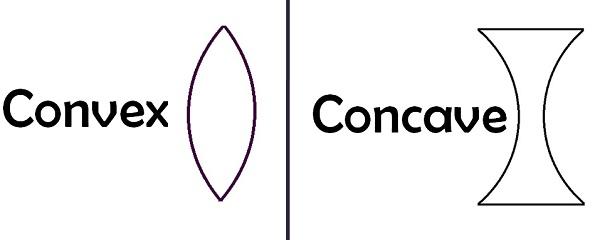
Fig.1. Spherical mirrors
Some Important Terms
Pole- The centre of the reflecting surface in a spherical mirror is a pole. It is represented by P.
Centre of curvature- Reflecting surface in a spherical mirror has a centre, this is known as centre of curvature. Centre of curvature in convex mirror lies behind the mirror whereas in concave mirror, it lies in front of the mirror.
Radius of curvature- The radius of the reflecting surface of the spherical mirror is known as radius of curvature. It is represented by R.
Principal axis- Straight line passing through the pole and centre of curvature in a spherical mirror is known as principal axis.
Principal focus- The reflected rays appear to come from a point on the principal axis, this is known as principal focus.
Focal length- The distance between the pole and the principal focus in a spherical mirror is known as focal length and it is represented by f.
Aperture- The diameter of the reflecting surface is defined as aperture.
Note: Radius of curvature is twice the focal length (R=2f).
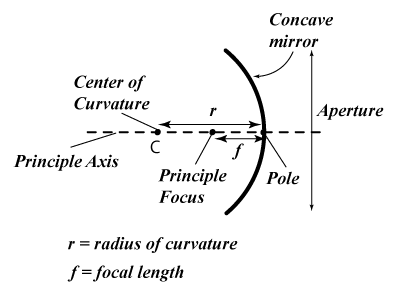
Fig.2. Image showing pole, principal axis, centre of curvature, aperture and principal focus in concave mirror
Representations of the images formed by Spherical Mirrors using Ray Diagrams
We draw the ray diagram to locate the image of an object formed. The intersection point of at least two reflected will give the position of image of the point object. The two rays that can be used to draw the ray diagram are-
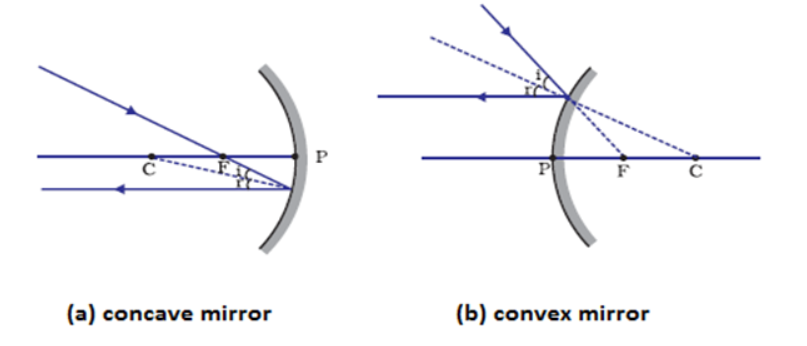
A ray parallel to the principal axis should pass through the focus after reflection in case of concave mirror, or appear to diverge in case of convex mirror.
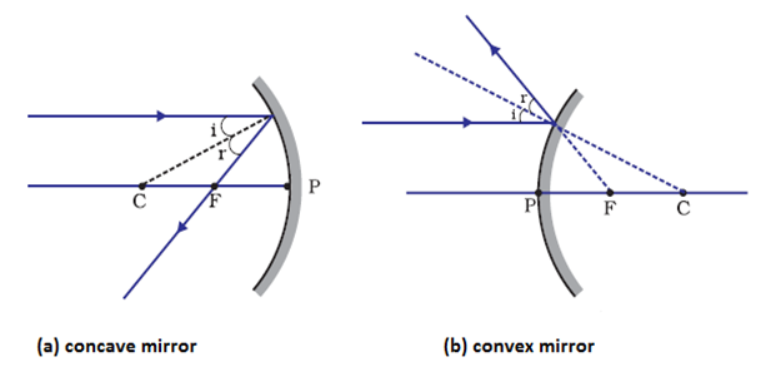
A ray passing through the focus of the concave mirror or directed towards the focus in case of convex mirror, should appear parallel to the principal axis after reflection.
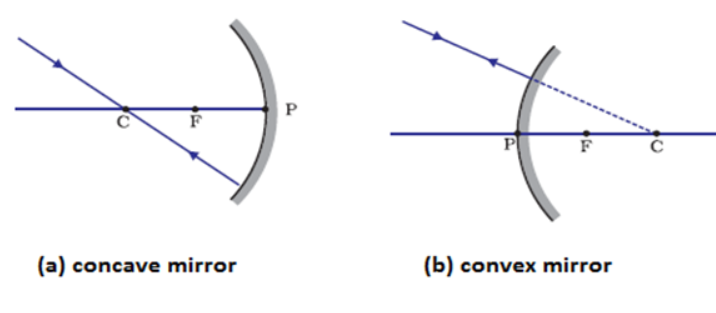
A ray which is passing through the centre of curvature in a concave mirror or directed in case of convex mirror, should reflect along the same path.
A ray when incident obliquely to principal axis on a concave or convex mirror is also reflected obliquely.
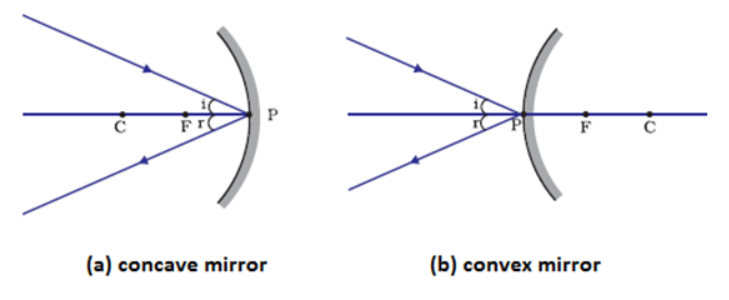
Image formation by Concave Mirror
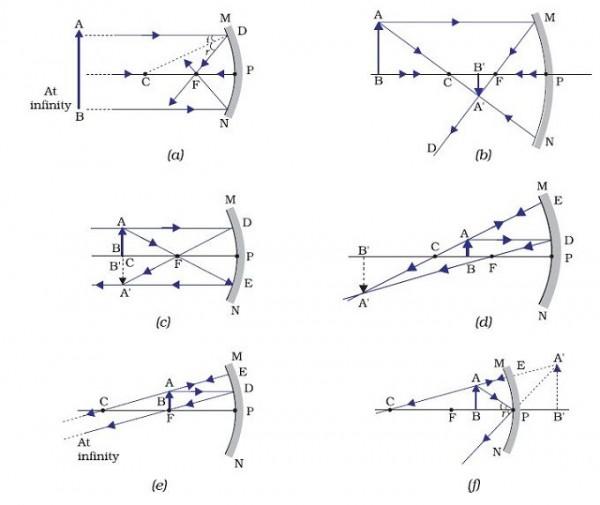
Fig. 3. Ray diagram for the image formation by concave mirror
Table.1. Nature, relative size and position of the image formed by concave mirror
Position, nature, and the size of the image formed by a concave mirror is dependent on the position of the object in relation to P, C and F. Image formed can be real or virtual. The image can also be magnified, diminished or even of the same size.
Uses of Concave Mirror
Used in search lights, torches, head lights of the vehicles. Also used in shaving mirrors. Used by dentists also to see larger image of the teeth. Other use in solar furnaces.
Image formation by Convex Mirror
Two positions of the object are considered while understanding the image formed by convex mirror. Either the object should be at infinity or at finite distance from the mirror. Formation of the image by the convex mirror are as follows-
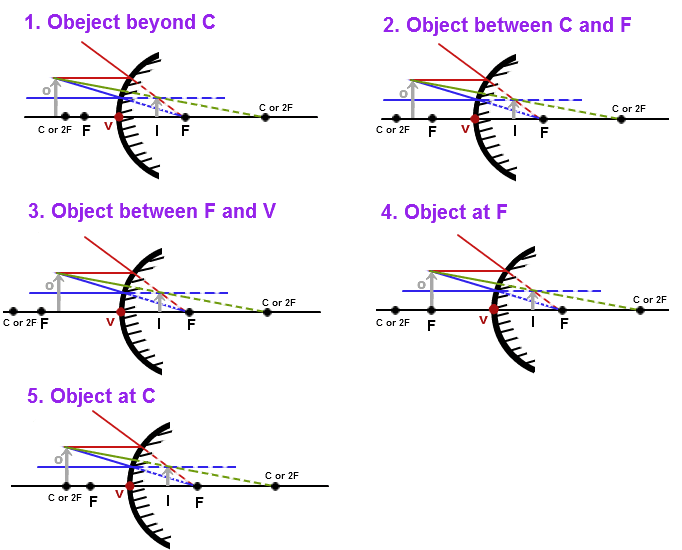
Fig. 5. Ray diagram for the image formation by convex mirror
Table.2. Nature, relative size and position of the image formed by convex mirror
Uses of Convex Mirror
They are used as rear-view mirrors. They are used to see the traffic behind. They are preferred as they give erect but diminished image.
Sign convention for reflection by spherical mirrors
New cartesian sign convention is used to give sign convention used for spherical mirrors. The conventions are as follows-
1. The object is always placed to the left of the mirror.
2. All distances parallel to the principal axis are measured from the pole of the mirror.
3. All the distances measured to the right of the origin (along + x-axis) are taken as positive while those measured to the left of the origin (along – x-axis) are taken as negative.
4. Distances measured perpendicular to and above the principal axis (along + y-axis) will be taken as positive.
5. Distances measured perpendicular to and below the principal axis (along –y-axis) will be taken as negative.
Mirror formula and magnification
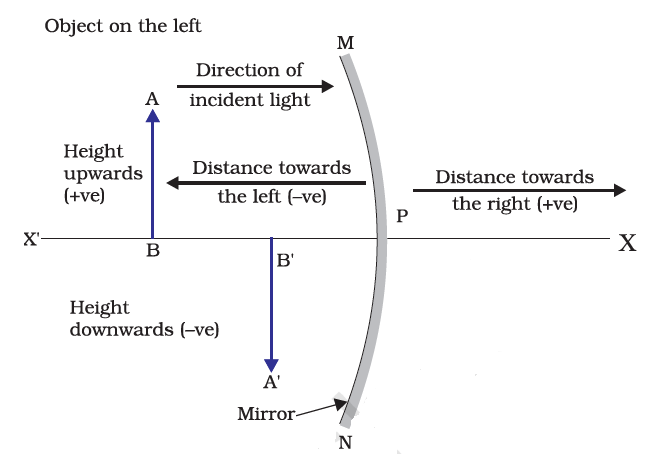
The distance of the object from its pole is known as object distance (u), whereas distance from the pole of the mirror is known as image distance (v). The mirror formula is given by-
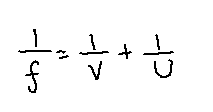
It is applicable for spherical mirrors in all positions of the object.
Magnification
It is defined as relative extent to which an object is magnified in comparison to its object size.
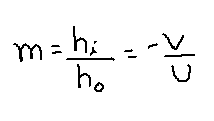
Where m is the magnification, ho is the height of the object and hi is the height of the image. However, it is to be taken as negative for real images. A negative sign in the value of magnification indicates that the nature of the image is real. A positive sign in the value of the magnification indicates the virtual nature of the image.
Refraction of light
Bending of the light rays as it passes from one medium to another medium is known as refraction of light.
Laws of Refraction
Incident ray, refracted ray and normal all lie in the same plane.
The ratio of sine of angle of incidence to the sine of angle of refraction is constant. This law is also known as Snell’s law of refraction.
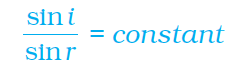
Refractive Index
When light passes from one medium to another medium, it changes its direction. The extent to which the direction changes is expressed in terms of refractive index. The value of refractive index is dependent on the speed of light in two media. v1 is the speed of light in medium 1 and v2 is the speed of light in medium 2. The refractive index of medium 2 with respect to medium 1 is represented as n21.

If medium 1 is vacuum or air, then the refractive index of medium 2 with respect to vacuum is known as absolute refractive index of the medium.

Where c is the speed of light in air, v is the speed of light in other medium and nm is the refractive index of the medium.
Refraction by Spherical Lenses
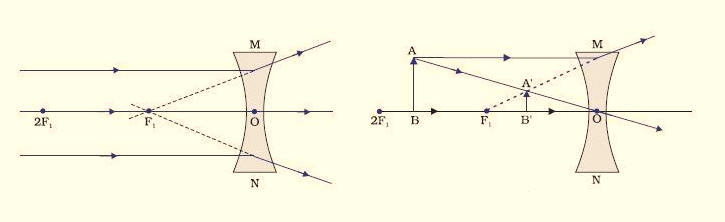
Lenses are defined as transparent materials which are bounded by two surfaces, out of which one or both can be spherical. When both the two spherical surfaces bulge outwards, it is known as convex lens. They converge the light rays. When the two spherical surfaces bulge inwards, they are known as concave lens. They are known as diverging lens. The centre of these spherical surfaces is known as centre of curvature, represented by C.
Any imaginary straight line passing through the centre of curvature of a lens is known as principal axis. The centre point is known as optical centre. The effective diameter of the spherical lens is known as aperture.
Image formation by lenses
Nature, relative size, and position of the image formed by convex lens are given below in the form of table-
Image formation in Lenses using Ray Diagrams
Rules for drawing the ray diagrams are as follows-
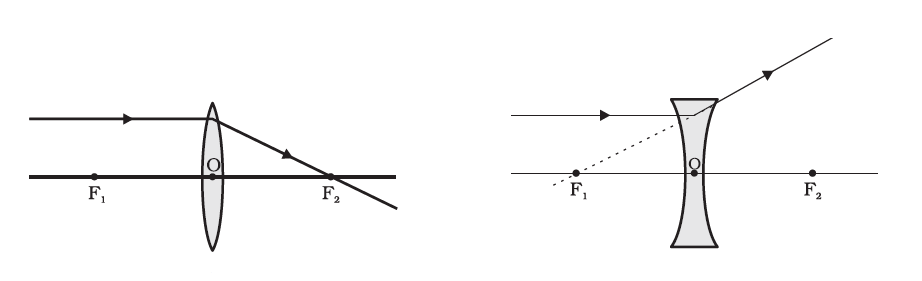
1. A ray of light which is parallel to the principal axis will pass through the principal focus after refraction from the convex lens.
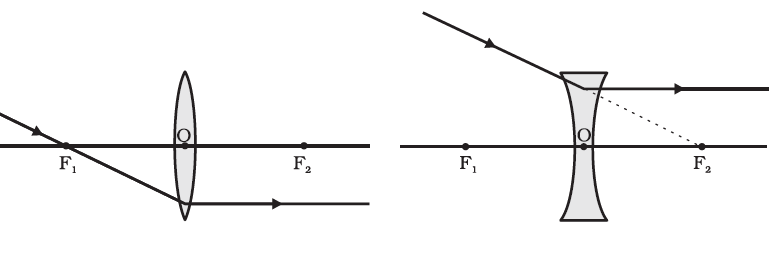
2. A ray of light passing through principal focus, will emerge parallel to principal axis after refraction from the convex lens.
3. A light ray passing through optical centre will emerge out without any deviation.
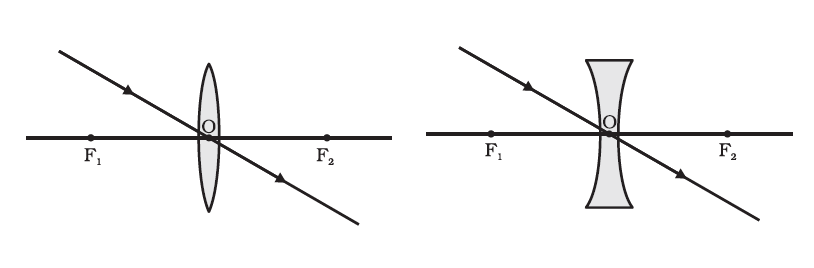
Image formed by the Convex Lens for various positions of the object
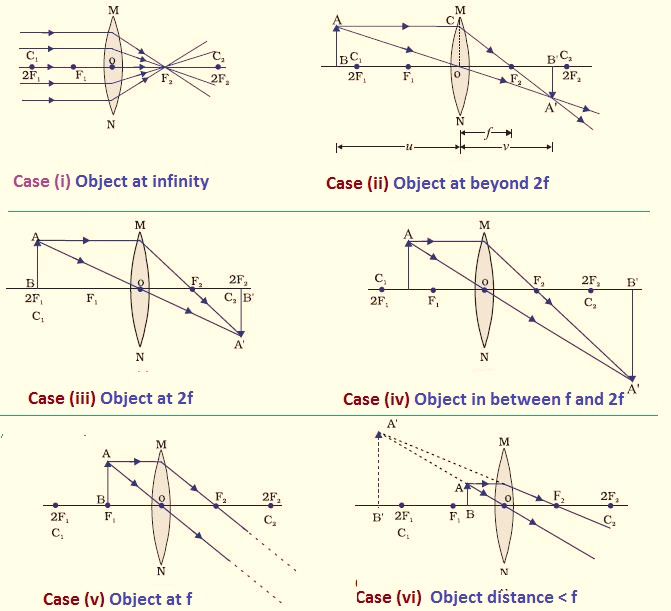
Image formed by the Concave Lens
Sign convention for Spherical Lenses
Sign convention are used as similar for spherical mirrors. But the focal length of a convex lens is positive and that of concave lens in negative.
Lens formula and magnification
The lens formula is given as
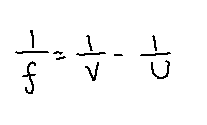
Where, u is object distance, v is image distance and f is focal length.
The ratio of the height of an image to the height of an object is defined as magnification.
Magnification is represented by m, h0 is the height of the object and hi is the height of the image.
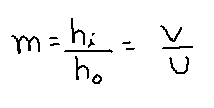
Power of a Lens
The degree of convergence or divergence of light rays is expressed in terms of power. So, the reciprocal of focal length is known as its power. It is represented by letter P. The power is given by-
P = 1/f
The SI unit of power is dioptre. It is represented by D. Power of concave lens is negative and power of convex lens is positive.
Revision Notes on The Human Eye and the Colourful World
Human Eye
It is one of the sensitive sense organs present in living organisms. It acts like a Camera.
The image is formed on light sensitive screen known as Retina.
Thin membrane through which light enters the eye is known as Cornea.
The eyeball is spherical in shape.
Presence of the crystalline lens helps in adjusting objects at different distances on the retina.
The dark muscular structure that controls the size of the pupil is known as Iris. Thus, pupil regulates the amount of light entering the eye.
Real, inverted image is formed on the retina. Retina contain light sensitive cells known as Rods and Cons. The light sensitive cells send signals to the brain via optic nerve.
Power of Accommodation
Focal lens of the eye lens can be decreased or increased. The lens become thin when the muscles are relaxed. This increases the focal length. This helps to see the distant objects. Similarly, when the eye lens become thick, focal length decreases and we are able to see nearby objects.
So, power of accommodation is defined as ability of the lens to adjust the focal length.
The minimum distance at which the particular object can be seen clearly is known as least distance of distinct vision. This is also called Near Point of the Eye. For young individuals, near point is about 25 cm. The farthest point to which an object can be seen is known as Far Point of the Eye. This is about 25 cm to infinity.
In old age people, the lens becomes milky and cloudy, this is known as Cataract. This can leads to complete or partial loss of vision.
Defects of the Vision and their Correction
The three common defects of vision are as follows-
Myopia (also known as Near Sightedness). In this case, distant objects cannot be seen clearly but nearby objects are clearly visible. Image is not formed on the retina, instead it is formed in front of the retina. Using concave lens of suitable power can be used to correct this defect.

Fig.1. Correction of Myopia
Hypermetropia also known as Far-sightedness. Nearby objects are not seen clearly whereas distant objects can be seen clearly. Image is formed behind the retina instead on the retina. Convex lens of appropriate power can be used to correct this defect.

Fig.2. Correction of Hypermetropia
Presbyopia is defined as the one in which power of accommodation decreases with ageing. They have difficulty in near vision. Ciliary muscles get weakened and the flexibility of the eye lens gets diminished. Generally, bifocal lens are used for correcting the defects.
Dispersion of White Light by Glass Prism
When light falls on the prism it splits the incident light into band of colours. The sequence of colours observed are VIBGYOR (Violet, Indigo, Blue, Green, Yellow, Orange and Red). This band of colour is known as Spectrum. So, this splitting of incident light into different colours is known as Dispersion. This splitting is due to bending of light rays at different angles. Violet light bends most whereas red light bends least. The phenomenon of rainbow is also due to dispersion of light.

Fig.3. Dispersion of White Light through Prism
The band of these seven colours formed because of dispersion of light is known as Spectrum.
Total Internal Reflection
When a light passes from denser to rarer medium and angle of incidence is greater than critical angle, the light will reflect in the denser medium. This is known as Total Internal Reflection.
Condition for Total Internal Reflection
Light should pass from denser to rarer medium
Angle of incidence should be greater than the critical angle.
Critical angle is defined as angle of incidence for which angle of refraction is 90 degrees
Atmospheric Refraction
Twinkling of Stars
When star light enters the atmosphere, it undergoes refraction. Due to this refractive index changes as the light bends towards the normal. The apparent position of the stars appears slightly different from the actual position. Since the physical conditions of the earth’s atmosphere are not stationary, the apparent positions of stars keep on changing. That is why they appear to twinkle.
Advance Sunlight and Delayed Sunset
The sun is visible 2 minutes before the actual sunrise or sunset appears 2 minutes after the actual sunset has taken place is due to atmospheric refraction.
Tyndall Effect
When beam of light strikes tiny water droplets, suspended particles of dust etc.(called as Colloidal Particles), the path of the beam becomes visible. This is known as Tyndall Effect. The colour of scattered light depends upon the size of colloidal particles. Very fine particles scatter mainly blue light while particles of larger size scatter light of longer wavelengths.
Why sky appears blue in colour?
The colour of the sky appears blue due to scattering of light. When the sunlight passes through the atmosphere, fine particles in air will scatter the blue colour more strongly than red.
Why sky appears red in colour during sunrise and sunset?

Fig.4. Reddening of Sun at rise and set
During sunrise and sunset, light from the Sun near the horizon passes through thicker layers of air and larger distance in the earth’s atmosphere before reaching our eyes. Light from the Sun overhead would travel relatively shorter distance, resulting in white appearance of sun. Near the horizon, most of the blue light and shorter wavelengths are scattered away by the particles. Therefore, the light that reaches our eyes is of longer wavelengths, hence the reddish appearance.
Revision Notes on Electricity
Charge
Protons and electrons possess some charge. Proton has positive charge. Electron has negative charge. Neutron does not possess any charge. Like charges repel each other and unlike charges attract each other.
Conductors and Insulators
Conductors are those materials in which electrons can move freely. All metals are conductors. Insulators do not have any free electrons to move. For example, wood and plastic.
Electric Current
The flow of electric charge is known as Electric Current. It is expressed in terms of rate of flow of charges.
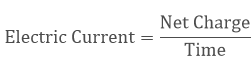
The SI unit of electric current is Ampere (A).
- Direction of electric current is same as direction of positive charges and opposite to the direction of flow of negative charges.
Potential Difference
Work done per unit charge in taking charge from one point to another is known as Potential Difference. The unit of potential difference is volt (V). 1V is defined as the potential difference between two points if 1 Joule of work is done to move 1 coulomb charge from one point to another.
Ohm’s law
Potential difference between two points is directly proportional to the current, provided temperature is constant.
V ∝ l
⇒ V = lR
R is a constant known as Resistance. The SI unit of resistance is ohm (Ω)
Factors on which resistance of a conductor depends-
It is directly proportional to length of conductor.
Inversely proportional to the area of cross-section.
Directly proportional to the temperature.
Depends on nature of material.
Resistivity
Resistivity is the property of the material. The SI unit of resistivity is ohm-metre.
Resistivity of metals varies from 10-8 to 10-6.
Resistivity of insulators varies from 1012 to 1017
Copper and aluminium are used in electrical transmission due to their low resistivity.
Resistance = Resistivity * Length of Conductor/Cross Sectional Area
Resistors in series
When two or more resistors are joined in series, then their total resistance is given by the formula-
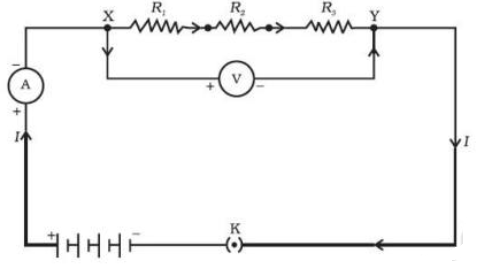
RS = R1 + R2 + R3
The current will remain same through all resistor. Total voltage is given by-
V = V1 + V2 + V3
Voltage across each resistor is given as –
V1 = lR1
V2 = lR2 [V1 + V2 + V3 = V]
V3 = lR3V = lR
⇒ V = lR1 + lR2 + lR3
lR = l(R1+ R2 + R3)
R = R1 + R2 + R3
Resistors in parallel
In this case, voltage is same across each resistor and is equal to applied voltage. Total current is given as-
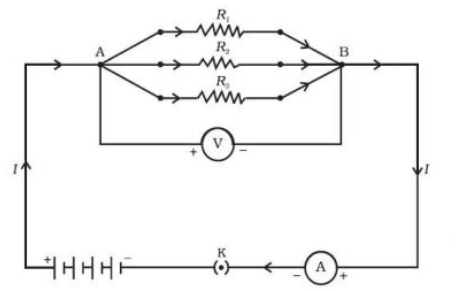
V/R = V/R1 + V/R2 + V/R3
1/Rp = 1/R1 + 1/R2 + 1/R3
Advantages of Parallel Combination over Series Combination
If one component fails in series combination, then complete circuit is broken and no component can work properly. Different appliances need different current, this can be met through parallel.
Heating effects of Electric Current
When charge Q moves against the potential difference V in time t, the amount of work is given by-
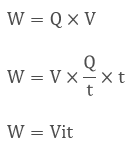
Joule’s Law of Heating
Heat produced in a resistor is directly proportional to square root of current.
It is also directly proportional to resistance for a given current.
Also, directly proportional to time
H = l2 Rt
Filament of electric bulb is made up of tungsten because it has a very high melting point and also does not oxidize readily at a high temperature.
Electric fuse is a safety device to protect the electrical appliance from short circuit.
Electric Power
The rate at which electric energy is dissipated or consumed in an electric current. The SI unit of power is Watt.
P = Vl
⇒ P = l2 R = V2/R
The commercial unit of electric energy is kilowatt hour (KWh
Revision Notes on Magnetic Effect of Electric Current
Any substance that attracts iron and iron like objects is defined as magnet. When a wire carries an electric current, it behaves as a magnet.
Properties of Magnet
Every magnet has north and south poles.
Same poles repel each other and unlike poles attract each other.
A freely suspended magnet will align itself in north south direction, north facing north of the magnet and south facing south of the magnet.
Characteristics of Field Lines
Field lines arise from north pole and end into south pole of the magnet.
They are closed curves.
Field lines never intersect each other.
Direction of magnetic field lines inside the magnet is from south to north.
Magnetic Field of a Bar Magnet
Hold the thumb, forefinger and middle finger of right hand at right angles to each other. If the forefinger is in direction of magnetic field and the thumb points in the direction of motion of conductor, than the direction of induced current is indicated by middle finger
Magnetic Field due to current through a Straight Conductor
They are represented in the form of concentric circles at every point on conductor.

Fig.1. Magnetic field through a straight conductor
Direction of the field is given by compass or right-hand thumb rule. Circles are always closer near the conductor.
Magnetic field due to current through a circular loop
It is represented by concentric circle at every point. Circle will become larger and larger as one move away.

Fig.2. Magnetic field
Factors affecting magnetic field of a circular current carrying conductor-
Magnetic field is directly proportional to the current passing through the conductor.
Magnetic field is inversely proportional to the distance from the conductor.
Magnetic field is directly proportional to number of turns in coil.
Solenoid
Solenoid is defined as coil of many circular turns of insulated copper wire wrapped closely in a cylindrical form. Magnetic field of solenoid is similar to bar magnet.

Fig.3. Current carrying solenoid
Electromagnet
It is temporary magnet that can be easily demagnetized. In this type of magnet, polarity can be reversed and strength can be varied. They are very strong magnet.
Permanent Magnet
These types of magnet cannot be easily demagnetized. They are weak magnets in which polarity cannot be reversed.
Force on a current carrying conductor in a magnetic field
The displacement in the conductor is the maximum when the direction of current is at right angle to the direction of magnetic field.
Flemings Left Hand Rule
Stretch the thumb, forefinger and middle finger of the left hand such that they are mutually perpendicular. If the forefingers is in the direction of the magnetic field, middle finger in the direction of current then thumb will point in the direction of motion or force.

Fig.4. Fleming left hand rule
Electric Motor
A rotating device that converts electrical energy to mechanical energy.

Fig. 5. Electric motor
It consists of rectangular coil ABCD made up of insulated copper wire. The coil is placed perpendicular to magnetic field. There are two conducting brushes X and Y. Current in coil ABCD enters through a source battery through conducting brush X and flows back to the battery through brush Y. The split ring acts as commutator. It reverses the direction of flow of current in a commutator.
They are used in electromagnets, as soft iron core on which coil is wound. Armature enhances the power of the motor.
Electromagnetic Induction
When we place a conductor in a changing magnetic field, some current is induced in it. This current is known as Induced Current and the phenomenon is known as Electromagnetic Induction.
Fleming Right Hand Rule

Fig.6. Fleming right hand rule
Hold the forefinger, middle finger and thumb of right hand at right angles to each other. Forefinger points towards the direction of magnetic field, thumb points in the direction of motion of conductor and middle finger shows direction of induced current.
Electric Generator
Electric Energy is a device used to convert mechanical energy into alternating form of electrical energy. It consists of insulated copper wire, magnetic poles, split rings, axle, brushes and galvanometer.

Fig.7. Electric generator
The axle is rotated so that it moves clockwise direction that is AB moves up and CD moves down. After half rotation, CD starts to move up and AB moves down. After every half rotation current changes its direction, this is called AC current.
Domestic Electric Circuits
Three kinds of wires are used in domestic electric circuits.
Live wire red in colour
Neutral wire with black insulation cover
Earth wire with green insulation cover.
The potential difference between live and neutral wire in India is 220V.
Electric Fuse
It is a safety device to limit the current in an electric circuit.
It prevents the electric appliances from damage.
It is made up of material which has high resistivity and low melting point.
Revision Notes on Sources of Energy
The largest source of energy on land is sunlight. There are different purposes for which energy is needed such as for food, for lightning, transport, running machines etc.
A good source of energy should be-
Cheap and easily available.
Safe in handling and use.
Do not cause any environment pollution.
Easy to store and transport.
Fuels
Materials that are burnt and used to store energy are defined as fuels. For Example, Wood, Coal etc.
Features of Good Fuel-
It should have high calorific value.
It should not produce smoke while burning.
Cheap and easily available.
Easy to handle and safe to transport.
Convenient in storage.
Sources of Energy
There are two types of Sources of Energy - Conventional Sources of Energy and Non-conventional Sources of Energy. Conventional sources of energy include the fossil fuels such as coal and petroleum. Non-conventional sources include solar cooker, solar cell panel etc.
Conventional Sources of Energy
Fossil Fuels
These fuels are developed from fossils.
They are present in limited amount.
They are non-renewable sources of energy.
These fuels cause pollution. They release different oxides which causes acid rain which damages plants, animals, houses etc. Excessive release of carbon-dioxide also causes global warming.
Pollution by the fossil fuels can be controlled by increasing the efficiency of combustion process and using other techniques to escape the harmful gases.
Thermal Power Plants
Thermal power plant is used to generate electricity using heat. Burning of fossil fuels produces the steam which is used to run the turbines. This method helps in efficient transmission of electricity.
Hydro Power Plants
Use to convert potential energy of falling water into electricity. They are associated with dams. They do not cause any pollution. Dam construction also prevents flooding of rivers and also provide water for irrigation.
But there are certain disadvantages associated with hydro power plants. Large areas are needed for hydro power plants. Human settlement is affected as well as large ecosystems are destroyed.
Biomass
The dead remains of plants and animals is known as Biomass.
Wood: It produces biomass and can be used as fuel for a long time. It produces smoke during burning. It does not produce much heat.
Charcoal: When wood is burnt in limited supply of oxygen, it produces charcoal. Charcoal is a better fuel than wood as it has high calorific value. It does not produce smoke while burning.
Cow Dung: It produces lots of smoke. It does not completely burn. It has low calorific value. It also produces ash.
Bio Gas: Biogas plant produces biogas. It is an excellent fuel. It leaves no residue. Has a very high heat capacity. Biogas plant is used to treat farm wastes or energy crops. Biogas plant consists of large tank or digester. In this bacteria convert organic waste into methane gas using energy.
Wind Energy: Unequal heating of the water bodies and the landmasses by solar radiations will generate air movement and cause the wind to blow. This energy is used to generate electricity. It is an eco-friendly method and an efficient source of renewable energy.
Non-conventional Sources of Energy
Solar Energy: solar energy is the ultimate source of energy. There are different solar energy devices such as Solar Cooker, Solar Water heaters, Solar cells etc.
Energy from the sea comes from surface waves and tidal power is obtained from kinetic energy of large bodies of moving water. Ocean water provide large amount of renewable energy.
Solar cooker use minimal fuel consumption and is a device that uses direct sunlight to cook or heat the drinks, food materials etc.
Solar cell is an electrical device that converts light energy into electricity. It is based on physical and chemical formula.
Geothermal Energy: energy from the rocks present inside the earth. It does not cause any pollution and economic also. But the disadvantage is that, it is not available everywhere.
Nuclear Energy: nuclear fission and nuclear fission helps in generation of nuclear energy. Fission involves the splitting of heavy nucleus of a radioactive atom. Nuclear fusion occurs when heavy nucleus is combined to release large amount of energy.
Environment Consequences
No source of energy is pollution free. They cause little or more pollution. Though solar cells do not produce any pollution, but its set up can cause environmental damage.
Revision Notes on Our Environment
Things around us is known as Environment. It consists of living component also known as biotic component and non-living component also known as Abiotic Component.
Ecosystem
The interaction between abiotic and biotic components is defined as ecosystem. It is a self sustaining and functional unit of biosphere. The term ecosystem was coined by Sir Arthur Tansley (OLYMPIAD)
Types of Ecosystem
There are two types of ecosystem- natural ecosystem and artificial ecosystem. The ecosystem present naturally is known as Natural Ecosystem. Example of Natural Ecosystem are forests, grasslands, deserts, ponds, lakes, rivers, estuaries, sea. The ecosystem which is man-made is known as Artificial Ecosystem. For Example Gardens, Aquariums and Agro ecosystem which is the largest manmade ecosystem.

Fig.1. Components of ecosystem
Abiotic Factors Include - Climatic factors such as rain, temperature, wind etc. Another abiotic factor is edaphic factors such as soil, pH, minerals etc.
Biotic Factors Include-
Producers which can make their own food, such as plants, blue green algae etc.
Consumers feed on producers. Such as herbivores. In consumers there are- primary consumers, secondary consumers, tertiary consumers etc.
Carnivores are flesh eating animals.
Omnivores consume both plants and animals.
Parasites live inside and depend upon living host.
Saprophytes feed on dead remains of plants and animals.
Food Chain is defined as series of organisms in order in which organisms feeds on another organism. There are various steps in food chain in which energy is transferred, each level is known as trophic level. Energy is always transferred unidirectionally.
Characteristics of food chain
There is a unidirectional flow of energy from producers to consumers.
There are generally 3 to 4 trophic levels.
It is always straight
Organism can occupy different trophic levels in different food chain.
A 10 percent law is followed in energy transfer which was given by Raymond Lindeman. This law states that “only 10 percent of energy is transferred from one trophic level to another trophic level”. The remaining 90 percent will be used by the present trophic level in different processes. Therefore there are usually 3-4 trophic levels in a food chain.

Fig.2. Energy transfer in trophic level
Food web
Interconnection of food chain is known as Food Web. It shows how food chain are interdependent.
Characteristic of Food Web
Food webs are never straight as they are formed by interlinking of food chains.
Food web provides alternative pathways of food availability. If a particular species is destroyed, the predator can feed on an alternative species.
Food webs increase ecosystem stability.

Fig.3. Food web
Ecological Pyramids
Ecological Pyramid is a graphical representation to show biomass or bioproductivity. There are different ecological pyramids such as pyramid of biomass, pyramid of number and pyramid of energy. Pyramid of number indicates number of individuals at different trophic levels. Pyramid of biomass indicates biomass of the members of the food chain present at different trophic levels. Pyramid of energy indicates energy at different trophic levels.

Fig.4. Upright Pyramids
Pyramid of number and pyramid of biomass can be inverted also. In aquatic ecosystem pyramid of biomass is inverted.

Fig.5. Inverted pyramid
Impact of Human Activities
Biological Magnification
The concentration of harmful substances increases with every trophic level. This is known as Biomagnification. Addition of pesticides in one trophic level increases the concentration of pesticides in other trophic level.

Fig.6. Biomagnification
Ozone Layer
High UV radiation break down oxygen into oxygen atoms. These oxygen atoms when combine with oxygen, they form ozone.
Depletion of Ozone Layer
The thickness of the ozone layer over Antarctica was found to be decreased in the year 1985. This is defined as ozone depletion. This is due to excessive use of chlorofluorocarbons in refrigerators, ACs, aerosols, etc. Thinning of ozone would allow penetration of Ultraviolet rays into earth’s atmosphere causing blindness, skin cancers and mutations.
In 1987 United Nations Environment Programme (UNEP) signed an agreement to limit the usage of CFCS. This is known as Montreal Protocol.

Fig.7. Reaction of CFC with ozone
Consequences of Ozone Depletion
Exposure of UV rays causes skin cancer. UV-rays damage the eyes also. It affects humans, plants as well as animals.
Garbage Disposal
Waste materials are known as garbage. There are two types garbage - Biodegradable Garbage and Non-biodegradable Garbage.
Garbage that can be completely decomposed by the microorganism are called Biodegradable Garbage., such as fruit and vegetable peel, sewage.
Substances which cannot be decomposed through microorganisms are known as Non-biodegradable Garbage, For Example, Plastic, Glass, Pesticide, Metals, Radioactive Elements etc.
Methods of Waste Management
Waste disposal is a very important part of day to day life. There are different methods of waste disposal management- sewage treatment plant, biogas plant, land fillings, recycling, incineration, composting and reuse.
Revision Notes on Management of Natural Resources
Natural Resources are obtained from earth and its environment. Natural resources are classified as-
Renewable resources which are continuously available for use. They do not get exhausted with time. For Example, Sunlight, Wind, Water etc.
Non-renewable Resources are those which gets exhausted with time. They are present in limited amount on the earth. For Example, Minerals.
Natural Resources are also classified as biotic and abiotic resources.
Biotic Resources can be obtained from forests, animals etc. For Example, Fossil Fuels.
Abiotic Resources are those that come from non-living and non-organic material.
There are three important terminologies used which are as follows-
Refuse: Say no to things that are offered to an individual. For Example, an individual say no to buy plastic products.
Reduce: Minimize the use of anything. For Example, minimize the use of fans, tubelights etc.
Reuse: To use the things again and again is defined as reuse.
Repurpose: When a particular thing cannot be used for a purpose, it can be used for another purpose.
Recycle: When the material can be used to make the needed things.
Why do we need to manage the resources?
We need to manage the resources because they are present in limited quantity. With the increase in population, the demand for resources are increasing. So, there is a need to manage the resources to minimize their use and preventing the exploitation of resources.
Forests and Wildlife
Forests are biodiversity hotspots. Biodiversity is defined as different types of organism present on the earth. The main aim of conservation is to preserve the biodiversity. The loss of biodiversity will lead to loss of ecological stability.
Stakeholders
Stakeholders who are-
They are the people living around the forests are dependent on forest and its products.
Forest department of the government owns the land and also control the resources from forests.
Industries that use forest produce .For Example Timber, Paper, Resin, Gum medicines, Sports equipment industries.
Wildlife and natural enthusiast who want to conserve the nature.
Bamboo is used to manufacture huts, baskets and also for food storage. Implements used in agriculture, fishing is largely made up of wood. The government of India has recently instituted an Amrita devi bishnoi national award for wildlife conservation in the memory of an Amrita Devi bishnoi who sacrificed her life to protect the trees in 1731.
Management of Forest
Local communities have been working traditionally for conservation of forests and trees. Magsaysay Award recipient Sunderlal Bahuguna gave momentum to the Chipko Andolan. The Chipko Andolan was started in Reni in Garhwal. It was started by villagers especially by women at Reni village who tried to stop the commercial wood contractors from cutting the tree by hugging the trunk of the trees.
People Participation in the Management of Forests
The acceptance of locals who live in harmony with natural resources is vital for forest conservation measures. In 1972, the West Bengal forest department found that they have failed in maintaining the degraded Sal forests. Surveillance and policing had led to complete alienation of the people which led to clashes between forest officials and villagers. So, to overcome this, department was forced to changed the strategy. Forest officer A.K. Banerjee involved villagers in protection of 1272 hectares of badly degraded Sal forests in Arabari forest range of Midnapore district. In return he allowed villagers to collect fuelwood and fodder on payment of nominal fee. Also 25% of final harvest was given to village community.
Methods of Forest Conservation
One of the most common method of forest conservation is silviculture. It is a method in which trees are grown and cultivated.
Social forestry deals with the management and protection of the forest.
Agroforestry includes land management for the cultivation of trees or shrubs.
Red Data Book
It is a document for recording the list of the endangered and rare species of animals, plants, fungi as well as some local species also.
Water for all
Water is required for fulfilling the basic needs of individuals. Human activities have altered the availability of water in various regions. Rain in India are due to monsoon. Common irrigation methods such as dams, canals and tanks are used in various parts of India. These methods are maintained by local people. This helps in storing water which can be used in agriculture. Not only in agriculture, daily needs of the common people can be met through this water.
Ganga Action Plan
This plan was launched by Shri Rajeev Gandhi in 1986. It is to improve the water quality of ganga by treatment, diversion and interception etc. It also includes treatment of domestic sewage and industrial effluents before releasing them into water bodies.
Dams
Large dams are made to store water that can be used in irrigation, in generating electricity etc. Indira Gandhi canal in Rajasthan areas has helped a lot in bringing greenery in different regions.
Dams control floods, provide water supply, electricity, waste management, recreation and wildlife habitat etc.
Criticism about large dams addresses three problems in particular- social problems, economic problems and environment problems
Construction of dams causes problems such as excessive sedimentation, water logging, sudden floods, soil erosion, large scale deforestation, health hazards, loss of livelihood etc.
Ancient Method of Watershed Management System
Different methods of watershed management system are known since ancient times. One of the method known as Khadins in Rajasthan which consists of a long earthen embankment built across the lower hill slopes. The area enclosed by the embankment is called as ‘bund’ which collects huge amount of rainwater which flows down the slopes. Subsequently this water saturated land is used for crop production.

Figure 1: Khadin in Rajasthan- An ancient method of watershed management.
Talabs are other mode of watershed management system known so far. It stores water for drinking and household consumption purposes. Others include kulhs in Himachal Pradesh,, Ahar and Pynes in Bihar, Eris in Tamil Nadu, Bundhis in Madhya Pradesh, Surangams in Kerala etc.
Coal and Petroleum
They are the non-renewable natural resources.
Coal is formed by the remains of the trees buried inside the earth.
Petroleum is formed by the bacterial decomposition of dead plants and dead animals. High pressure and temperature are needed for the formation of petroleum.
Both coal and petroleum are fossil fuels.
They are getting used up at higher rate, so there are more chances that they get exhausted soon.
Disadvantages of Fossil Fuels - Burning of fossil fuels release large amount of carbon-dioxide, sulphur dioxide and other harmful gases. This causes air pollutions and the harmful effects of air pollution. This also raises the earth temperature and thus leads to global warming.
Steps to minimize the pollution from Fossil Fuels
Reduce the use and burning of fossil fuels.
Use of CNG in transport vehicles to reduce pollution.
Alternative sources of energy such as Hydroelectricity, nuclear, solar, wind power and biogas should be used.
We hope the given Chapter Wise CBSE Quick Revision Notes and Key Points for Class 10 Science Pdf free download of physics, chemistry and biology notes will help you. If you have any query regarding NCERT

Comments
Post a Comment
Ask me anything here...