lesson 3-integers- 04 -04-2020
Integers - Lesson3
INTEGERS - Lesson 3
Good morning students.
Good morning students.
You are all very good with computers.
I am sure you have checked the answers from the back of the textbook. You can ask me or check for solutions online.
Textbook to be followed : NCERT
Sources : Youtube
Students you will be able to :
Extend your knowledge of closure ,commutative and associative property to addition and subtraction of whole numbers to integers.
Explanation
CLOSURE PROPERTY :
Closure property under addition –
Integers are closed under addition, i.e. for any two integers a and b, a + b is an integer.
Example = Explain Closure Property under addition with integers (-8) and 2
Answer = Find the sum of given Integers ;
(-8) + 2 = (-6)
Since (-6) is also an integer we can say that
Integers are closed under addition
Answer = Find the sum of given Integers ;
(-8) + 2 = (-6)
Since (-6) is also an integer we can say that
Integers are closed under addition
Closure property under subtraction –
Integers are closed under subtraction, i.e. for any two integers a and b, a – b is an integer.
Example = Explain Closure Property under subtraction for integers 10 and 5
Answer = Find the difference of the given integers ;
10 - 5 = 5
Since 5 is also an integer we can say that
Integers are closed under subtraction

Answer = Find the difference of the given integers ;
10 - 5 = 5
Since 5 is also an integer we can say that
Integers are closed under subtraction
COMMUTATIVE PROPERTY
Commuting means interchanging.
Commutative Property explains whether on changing the order of integers in an expression, the result changes or not.
Commutative Property explains whether on changing the order of integers in an expression, the result changes or not.
Commutative Property for Addition of Integers
Let us see if we change the order of integers in an addition expression, the result remains the same or not.
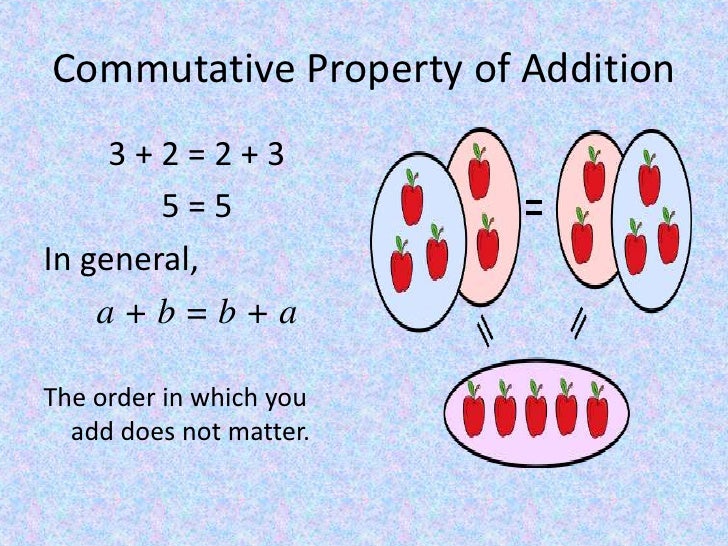
Example = Explain Commutative Property for addition of integers (-5) & (-7).
Answer = Given Integers = (-5), (-7) and their two orders are as follows :-
Order 1 = (-5) + (-7) = (-12)
Order 2 = (-7) + (-5) = (-12)
As, in both the orders the result is same i.e (-12),
So, we can say that Addition is Commutative for Integers.
Example = Explain Commutative Property for addition of integers (-5) & (-7).
Answer = Given Integers = (-5), (-7) and their two orders are as follows :-
Order 1 = (-5) + (-7) = (-12)
Order 2 = (-7) + (-5) = (-12)
As, in both the orders the result is same i.e (-12),
So, we can say that Addition is Commutative for Integers.
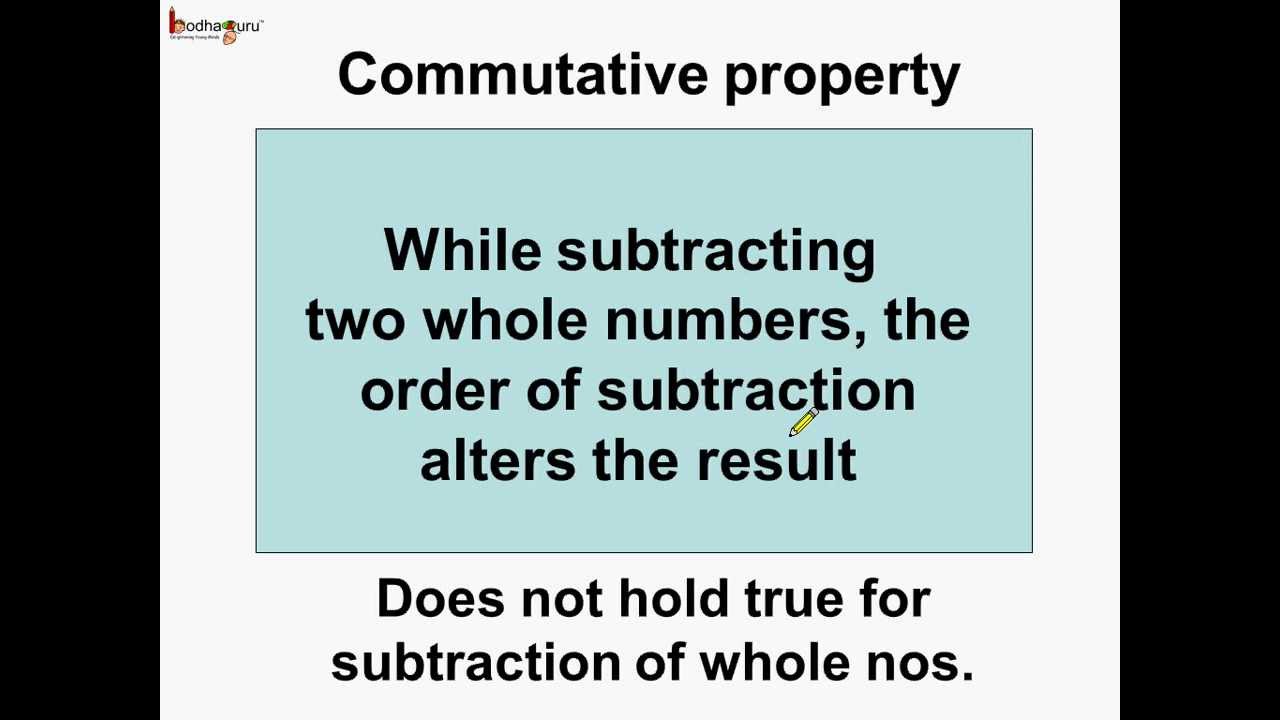
Commutative Property for Subtraction of Integers
https://i.ytimg.com/vi/Odqi4o_xAsY/maxresdefault.jpg
Let us see if we change the order of integers in subtraction expression, the result remains same or not.
Example = Explain Commutative Property for subtraction of integers (-7) & (-17) ?
Answer = Given Integers = (-7), (-17) and their two orders are as follows :-
Order 1 = (-7) - (-17) = 10
Order 2 = (-17) - (-7) = (-10)
As, in both the orders the result is different.
Example = Explain Commutative Property for subtraction of integers (-7) & (-17) ?
Answer = Given Integers = (-7), (-17) and their two orders are as follows :-
Order 1 = (-7) - (-17) = 10
Order 2 = (-17) - (-7) = (-10)
As, in both the orders the result is different.
So, we can say that Subtraction is not commutative for integers.
ASSOCIATIVE PROPERTY
Make different groups of whole numbers of a given expression and check if the result of all the groups is the same or not
Associative Property for Addition of Integers
If we make different groups with same given whole numbers, then also the sum in all the groups always remains the same.
Example 1 = Explain Associative Property for addition of 5, 6, 7 ?
Answer = Given Whole Numbers = 5, 6, 7 and their two groups are as follows :-
Group 1 = (5 + 6) + 7
= 11 + 7 = 18
Group 2 = 5 + (6 + 7)
= 13 + 7 = 18
As, in both the groups the sum is same i.e 18
So, we can say that Addition is Associative for integers.
Answer = Given Whole Numbers = 5, 6, 7 and their two groups are as follows :-
Group 1 = (5 + 6) + 7
= 11 + 7 = 18
Group 2 = 5 + (6 + 7)
= 13 + 7 = 18
As, in both the groups the sum is same i.e 18
So, we can say that Addition is Associative for integers.
Associative Property for Subtraction of Integers
Example = Explain Associative Property for subtraction of 5, 6, 7 ?
Answer =
Answer =
Group 1 = (5 - 6) - 7 = (-1) - 7 = (-8)
Group 2 = 5 - (6 - 7) = 5 - (-1) = 6
In both the groups answer is different
So, we can say that Subtraction is not Associative for integers.
The link above helped us revise additive inverse which was done in Lesson 1 .
We have also been introduced to the term additive identity which will be done tomorrow
Take rest. Keep working
Home Assignments
Now you should be able to do NCERT Ex. 1.2 Q3,4
SINCE YOU HAVE A DOUBLE PERIOD TODAY LET ' S PRACTICE SOME BASIC INTEGERS .DO THE QUESTIONS BELOW IN YOUR NOTEBOOKS....

SINCE YOU HAVE A DOUBLE PERIOD TODAY LET ' S PRACTICE SOME BASIC INTEGERS .DO THE QUESTIONS BELOW IN YOUR NOTEBOOKS....