RD Sharma Solutions for Class 10 Maths Chapter 10 Circles
RD Sharma Solutions for Class 10 Maths Chapter 10 Circles
RD Sharma Class 10 Chapter 10 Exercise 10.1 Page No: 10.5
1. Fill in the blanks:
(i) The common point of tangent and the circle is called _________.
(ii) A circle may have _____ parallel tangent.
(iii) A tangent to a circle intersects it in ______ point.
(iv) A line intersecting a circle in two points is called a _______
(v) The angle between tangent at a point P on circle and radius through the point is _______
Solution:
(i) The common point of tangent and the circle is called point of contact.
(ii) A circle may have two parallel tangent.
(iii) A tangent to a circle intersects it in one point.
(iv) A line intersecting a circle in two points is called a secant.
(v) The angle between tangent at a point P on circle and radius through the point is 90° .
2. How many tangents can a circle have?
Solution:
A tangent is defined as a line intersecting the circle in one point. Since, there are infinite number of points on the circle, a circle can have many (infinite) tangents.
RD Sharma Class 10 Chapter 10 Exercise 10.2 Page No: 10.33
1. If PT is a tangent at T to a circle whose centre is O and OP = 17 cm, OT = 8 cm. Find the length of the tangent segment PT.
Solution:
Given,
OT = radius = 8 cm
OP = 17 cm
To find: PT = length of tangent =?
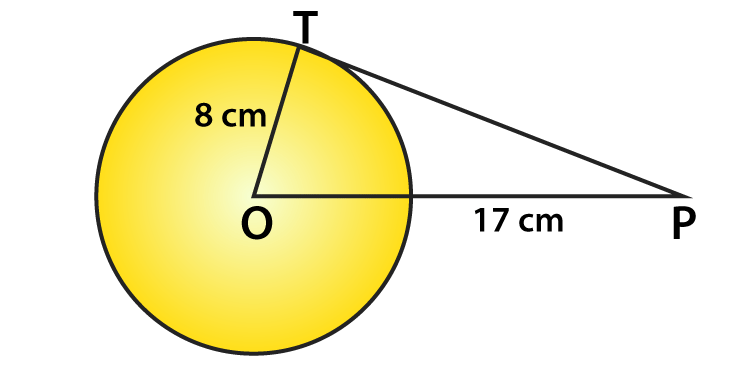
Clearly, T is point of contact. And, we know that at point of contact tangent and radius are perpendicular.
∴ OTP is right angled triangle ∠OTP = 90°, from Pythagoras theorem OT2 + PT2 = OP2
82 + PT2 = 172
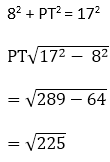
∴ PT = length of tangent = 15 cm.
2. Find the length of a tangent drawn to a circle with radius 5cm, from a point 13 cm from the center of the circle.
Solution:
Consider a circle with centre O.
OP = radius = 5 cm. (given)
A tangent is drawn at point P, such that line through O intersects it at Q.
And, OQ = 13cm (given).
To find: Length of tangent PQ =?
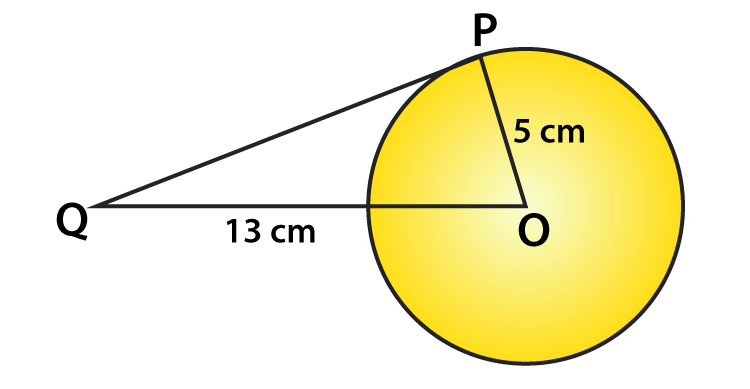
We know that tangent and radius are perpendicular to each other.
∆OPQ is right angled triangle with ∠OPQ = 90°
By Pythagoras theorem we have,
OQ2 = OP2 + PQ2
⇒ 132 = 52 + PQ2
⇒ PQ2 = 169 – 25 = 144
⇒ PQ = √114
= 12 cm
Therefore, the length of tangent = 12 cm
3. A point P is 26 cm away from O of circle and the length PT of the tangent drawn from P to the circle is 10 cm. Find the radius of the circle.
Solution:
Given, OP = 26 cm
PT = length of tangent = 10 cm
To find: radius = OT = ?
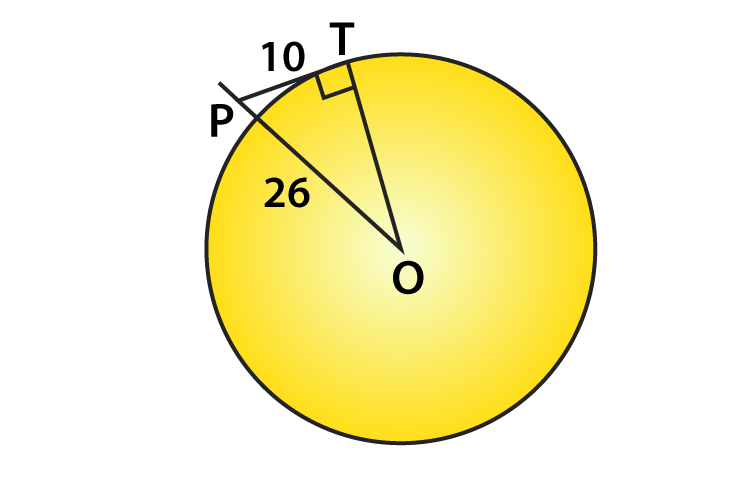
We know that,
At point of contact, radius and tangent are perpendicular ∠OTP = 90°
So, ∆OTP is right angled triangle.
Then by Pythagoras theorem, we have
OP2 = OT2 + PT2
262 = OT2 + 102
OT2 = 676 – 100
OT = √576
OT = 24 cm
Thus, OT = length of tangent = 24 cm
4. If from any point on the common chord of two intersecting circles, tangents be drawn to the circles, prove that they are equal.
Solution:
Let the two circles intersect at points X and Y.
So, XY is the common chord.
Suppose ‘A’ is a point on the common chord and AM and AN be the tangents drawn A to the circle
Then it’s required to prove that AM = AN.
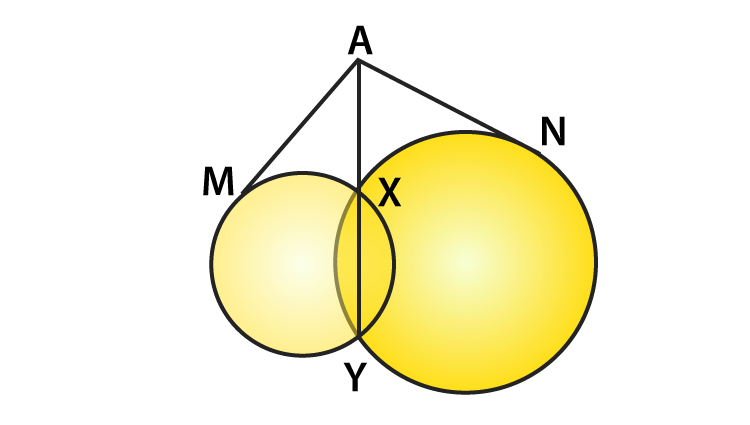
In order to prove the above relation, following property has to be used.
“Let PT be a tangent to the circle from an external point P and a secant to the circle through P intersecting the circle at points A and B, then PT2 = PA × PB”
Now AM is the tangent and AXY is a secant
∴ AM2 = AX × AY … (i)
Similarly, AN is a tangent and AXY is a secant
∴ AN2 = AX × AY …. (ii)
From (i) & (ii), we have AM2 = AN2
∴ AM = AN
Therefore, tangents drawn from any point on the common chord of two intersecting circles are equal.
- Hence Proved
5. If the quadrilateral sides touch the circle, prove that sum of pair of opposite sides is equal to the sum of other pair.
Solution:
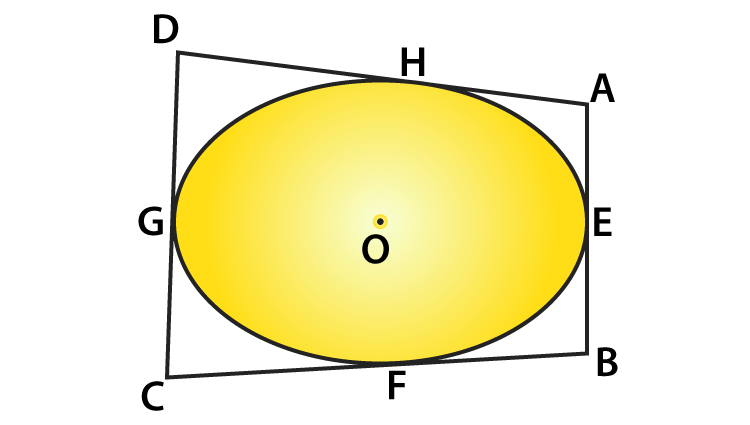
Consider a quadrilateral ABCD touching circle with centre O at points E, F, G and H as shown in figure.
We know that,
The tangents drawn from same external points to the circle are equal in length.
Consider tangents:
1. From point A [AH & AE]
AH = AE … (i)
2. From point B [EB & BF]
BF = EB … (ii)
3. From point C [CF & GC]
FC = CG … (iii)
4. From point D [DG & DH]
DH = DG …. (iv)
Adding (i), (ii), (iii), & (iv)
(AH + BF + FC + DH) = [(AC + CB) + (CG + DG)]
⟹ (AH + DH) + (BF + FC) = (AE + EB) + (CG + DG)
⟹ AD + BC = AB + DC [from fig.]
Therefore, the sum of one pair of opposite sides is equal to other.
- Hence Proved
6. Out of the two concentric circles, the radius of the outer circle is 5 cm and the chord AC of length 8 cm is a tangent to the inner circle. Find the radius of the inner circle.
Solution:
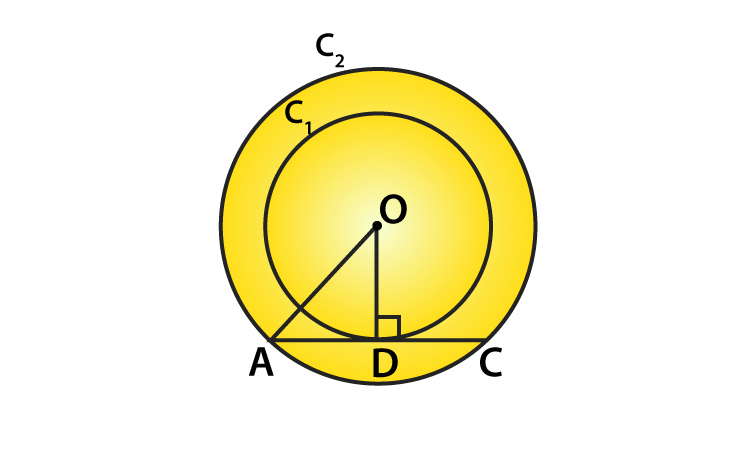
Let C1 and C2 be the two circles having same center O.
And, AC is a chord which touches the C1 at point D
let’s join OD.
So, OD ⊥ AC
AD = DC = 4 cm [perpendicular line OD bisects the chord]
Thus, in right angled ∆AOD,
OA² = AD² + DO² [By Pythagoras theorem]
DO² = 5² – 4² = 25 – 16 = 9
DO = 3 cm
Therefore, the radius of the inner circle OD = 3 cm.
7. A chord PQ of a circle is parallel to the tangent drawn at a point R of the circle. Prove that R bisects the arc PRQ.
Solution:
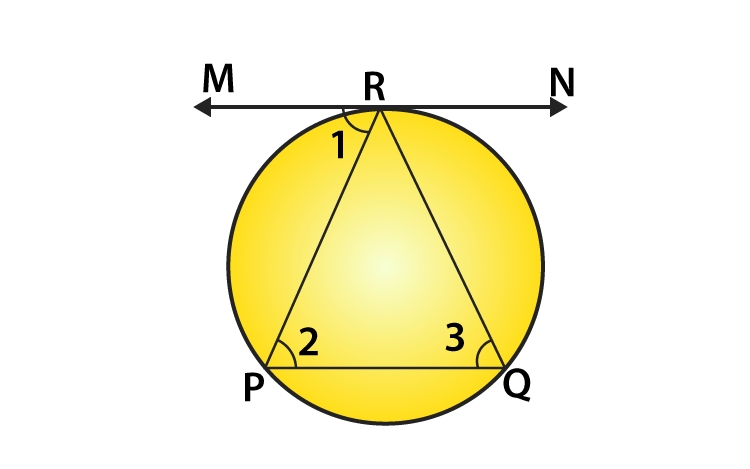
Given: Chord PQ is parallel tangent at R.
To prove: R bisects the arc PRQ.
Proof:
Since PQ || tangent at R.
∠1 = ∠2 [alternate interior angles]
∠1 = ∠3
[angle between tangent and chord is equal to angle made by chord in alternate segment]
So, ∠2 = ∠3
⇒ PR = QR [sides opposite to equal angles are equal]
Hence, clearly R bisects PQ.
8. Prove that a diameter AB of a circle bisects all those chords which are parallel to the tangent at the point A.
Solution:
Given,
AB is a diameter of the circle.
A tangent is drawn from point A.
Construction: Draw a chord CD parallel to the tangent MAN.
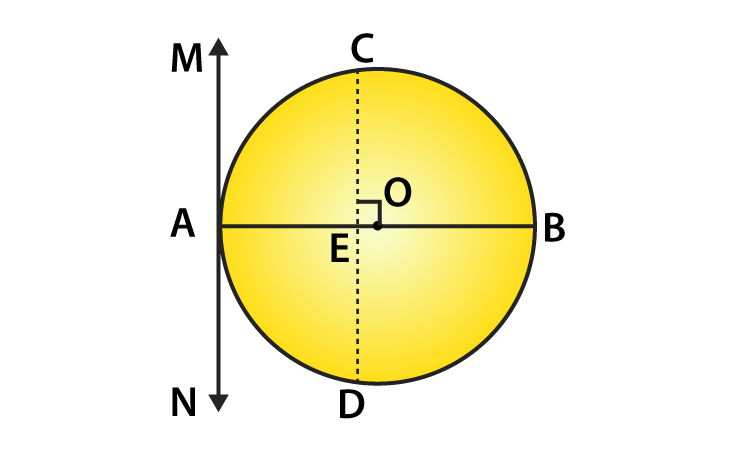
So now, CD is a chord of the circle and OA is a radius of the circle.
∠MAO = 90°
[Tangent at any point of a circle is perpendicular to the radius through the point of contact]
∠CEO = ∠MAO [corresponding angles]
∠CEO = 90°
Therefore, OE bisects CD.
[perpendicular from center of circle to chord bisects the chord]
Similarly, the diameter AB bisects all the chords which are parallel to the tangent at the point A.
9. If AB, AC, PQ are the tangents in the figure, and AB = 5 cm, find the perimeter of ∆APQ.
Solution:
Given,
AB, AC, PQ are tangents
And, AB = 5 cm
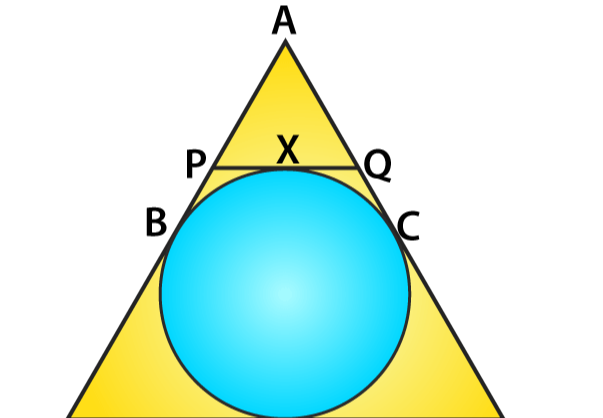
Perimeter of ∆APQ,
Perimeter = AP + AQ + PQ
= AP + AQ + (PX + QX)
We know that,
The two tangents drawn from external point to the circle are equal in length from point A,
So, AB = AC = 5 cm
From point P, PX = PB [Tangents from an external point to the circle are equal.]
From point Q, QX = QC [Tangents from an external point to the circle are equal.]
Thus,
Perimeter (P) = AP + AQ + (PB + QC)
= (AP + PB) + (AQ + QC)
= AB + AC = 5 + 5
= 10 cm.
10. Prove that the intercept of a tangent between two parallel tangents to a circle subtends a right angle at centre.
Solution:
Consider a circle with centre ‘O’ and has two parallel tangents through A & B at ends of diameter.
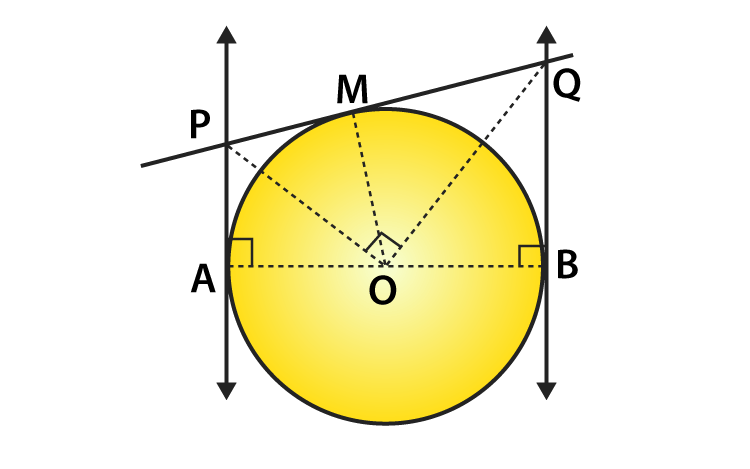
Let tangent through M intersect the parallel tangents at P and Q
Then, required to prove: ∠POQ = 90°.
From fig. it is clear that ABQP is a quadrilateral
∠A + ∠B = 90° + 90° = 180° [At point of contact tangent & radius are perpendicular]
∠A + ∠B + ∠P + ∠Q = 360° [Angle sum property of a quadilateral]
So,
∠P + ∠Q = 360° – 180° = 180° … (i)
At P & Q
∠APO = ∠OPQ = 1/2 ∠P ….(ii)
∠BQO = ∠PQO = 1/2 ∠Q ….. (iii)
Using (ii) and (iii) in (i) ⇒
2∠OPQ + 2∠PQO = 180°
∠OPQ + ∠PQO = 90° … (iv)
In ∆OPQ,
∠OPQ + ∠PQO + ∠POQ = 180° [Angle sum property]
90° + ∠POQ = 180° [from (iv)]
∠POQ = 180° – 90° = 90°
Hence, ∠POQ = 90°
11. In Fig below, PQ is tangent at point R of the circle with center O. If ∠TRQ = 30°, find ∠PRS.
Solution:
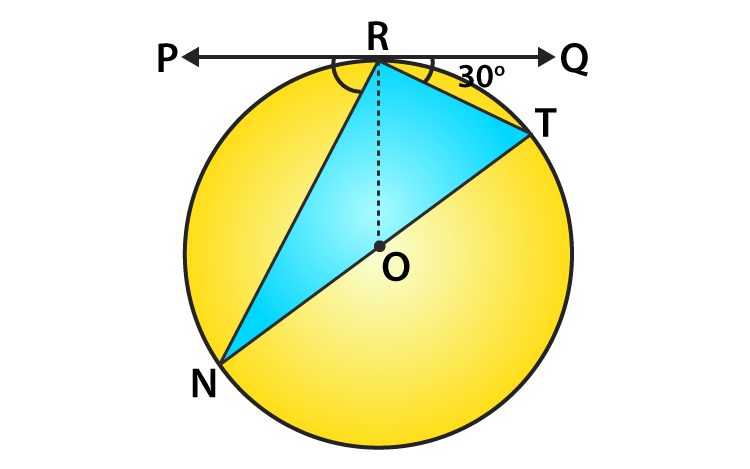
Given,
∠TRQ = 30°.
At point R, OR ⊥ RQ.
So, ∠ORQ = 90°
⟹ ∠TRQ + ∠ORT = 90°
⟹ ∠ORT = 90°- 30° = 60°
It’s seen that, ST is diameter,
So, ∠SRT = 90° [ ∵ Angle in semicircle = 90°]
Then,
∠ORT + ∠SRO = 90°
∠SRO + ∠PRS = 90°
∴ ∠PRS = 90°- 30° = 60°
12. If PA and PB are tangents from an outside point P. such that PA = 10 cm and ∠APB = 60°. Find the length of chord AB.
Solution:
Given,
AP = 10 cm and ∠APB = 60°
Represented in the figure
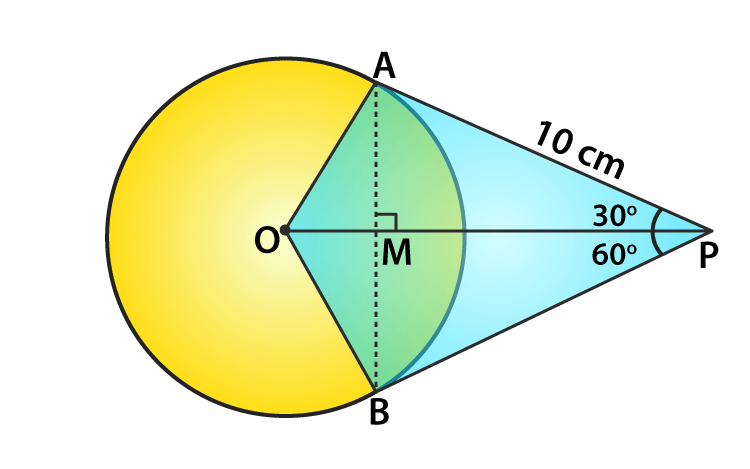
We know that,
A line drawn from centre to point from where external tangents are drawn divides or bisects the angle made by tangents at that point
So, ∠APO = ∠OPB = 1/2 × 60° = 30°
And, the chord AB will be bisected perpendicularly
∴ AB = 2AM
In ∆AMP,
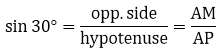
AM = AP sin 30°
AP/2 = 10/2 = 5cm [As AB = 2AM]
So, AP = 2 AM = 10 cm
And, AB = 2 AM = 10cm
Alternate method:
In ∆AMP, ∠AMP = 90°, ∠APM = 30°
∠AMP + ∠APM + ∠MAP = 180°
90° + 30° + ∠MAP = 180°
∠MAP = 60°
In ∆PAB, ∠MAP = ∠BAP = 60°, ∠APB = 60°
We also get, ∠PBA = 60°
∴ ∆PAB is equilateral triangle
AB = AP = 10 cm
13. In a right triangle ABC in which ∠B = 90°, a circle is drawn with AB as diameter intersecting the hypotenuse AC at P. Prove that the tangent to the circle at P bisects BC.
Solution:
Let O be the center of the given circle. Suppose, the tangent at P meets BC at Q.
Then join BP.
Required to prove: BQ = QC
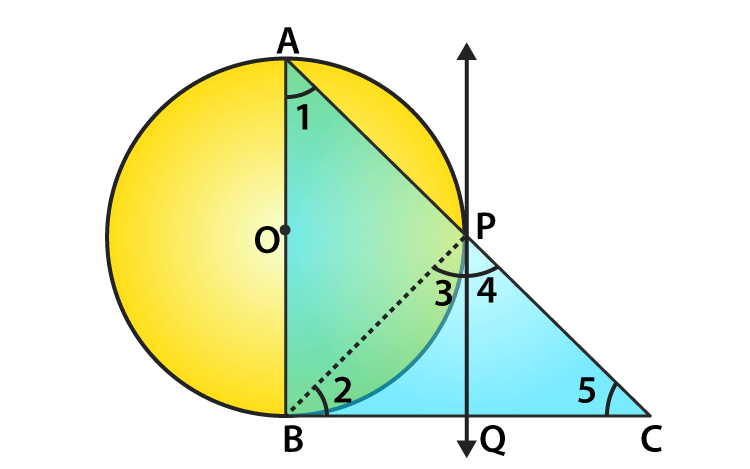
Proof :
∠ABC = 90° [tangent at any point of circle is perpendicular to radius through the point of contact]
In ∆ABC, ∠1 + ∠5 = 90° [angle sum property, ∠ABC = 90°]
And, ∠3 = ∠1
[angle between tangent and the chord equals angle made by the chord in alternate segment]
So,
∠3 + ∠5 = 90° ……..(i)
Also, ∠APB = 90° [angle in semi-circle]
∠3 + ∠4 = 90° …….(ii) [∠APB + ∠BPC = 180°, linear pair]
From (i) and (ii), we get
∠3 + ∠5 = ∠3 + ∠4
∠5 = ∠4
⇒ PQ = QC [sides opposite to equal angles are equal]
Also, QP = QB
[tangents drawn from an internal point to a circle are equal]
⇒ QB = QC
– Hence proved.
14. From an external point P, tangents PA and PB are drawn to a circle with centre O. If CD is the tangent to the circle at a point E and PA = 14 cm, find the perimeter of ∆PCD.
Solution:
Given,
PA and PB are the tangents drawn from a point P outside the circle with centre O.
CD is another tangents to the circle at point E which intersects PA and PB at C and D respectively.
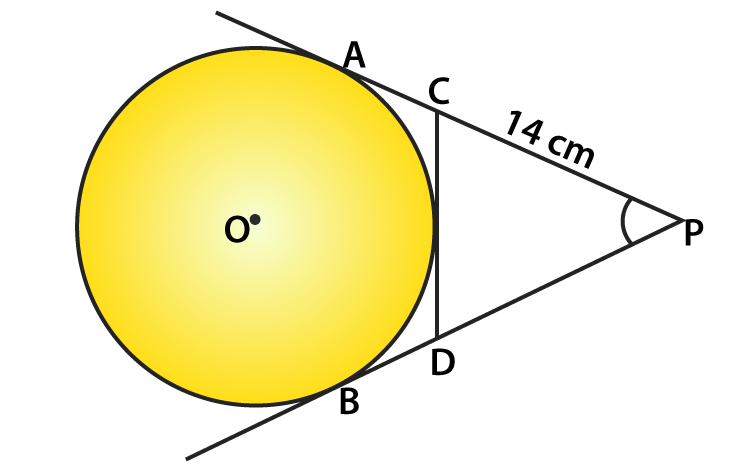
PA = 14 cm
PA and PB are the tangents to the circle from P
So, PA = PB = 14 cm
Now, CA and CE are the tangents from C to the circle.
CA = CE ….(i)
Similarly, DB and DE are the tangents from D to the circle.
DB = DE ….(ii)
Now, perimeter of ∆PCD
= PC + PD + CD
= PC + PD + CE + DE
= PC + CE + PD + DE
= PC + CA + PD = DB {From (i) and (ii)}
= PA + PB
= 14 + 14
= 28 cm
15. In the figure, ABC is a right triangle right-angled at B such that BC = 6 cm and AB = 8 cm. Find the radius of its incircle.
Solution:
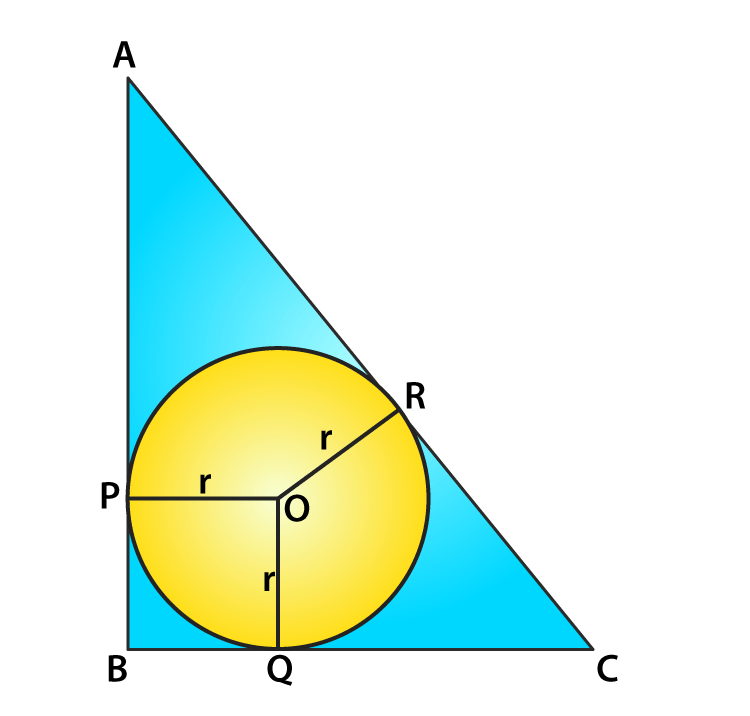
Given,
In right ∆ABC, ∠B = 90°
And, BC = 6 cm, AB = 8 cm
Let r be the radius of incircle whose centre is O and touches the sides AB, BC and CA at P, Q and R respectively.
Since, AP and AR are the tangents to the circle AP = AR
Similarly, CR = CQ and BQ = BP
OP and OQ are radii of the circle
OP ⊥ AB and OQ ⊥ BC and ∠B = 90° (given)
Hence, BPOQ is a square
Thus, BP = BQ = r (sides of a square are equal)
So,
AR = AP = AB – BD = 8 – r
and CR = CQ = BC – BQ = 6 – r
But AC² = AB² + BC² (By Pythagoras Theorem)
= (8)² + (6)² = 64 + 36 = 100 = (10)²
So, AC = 10 cm
⇒AR + CR = 10
⇒ 8 – r + 6 – r = 10
⇒ 14 – 2r = 10
⇒ 2r = 14 – 10 = 4
⇒ r = 2
Therefore, the radius of the incircle = 2 cm
16. Prove that the tangent drawn at the mid-point of an arc of a circle is parallel to the chord joining the end points of the arc.
Solution:
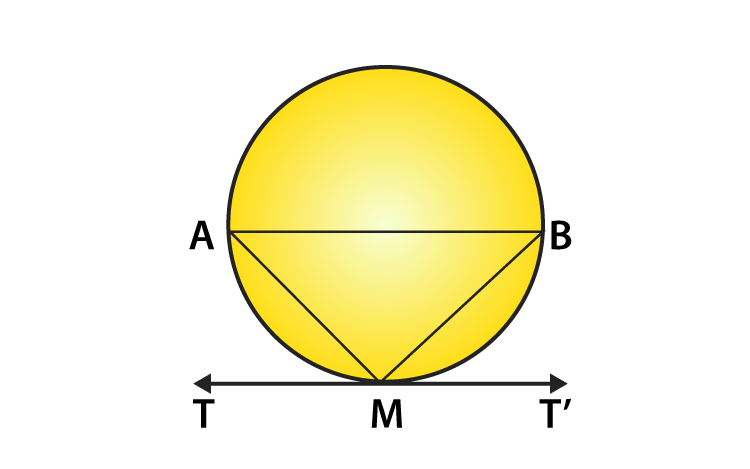
Let mid-point of an arc AMB be M and TMT’ be the tangent to the circle.
Now, join AB, AM and MB.
Since, arc AM = arc MB
⇒ Chord AM = Chord MB
In ∆AMB, AM = MB
⇒ ∠MAB = ∠MBA ……(i)
[equal sides corresponding to the equal angle]
Since, TMT’ is a tangent line.
∠AMT = ∠MBA
[angle in alternate segment are equal]
Thus, ∠AMT = ∠MAB [from Eq. (i)]
But ∠AMT and ∠MAB are alternate angles, which is possible only when AB || TMT’
Hence, the tangent drawn at the mid-point of an arc of a circle is parallel to the chord joining the end points of the arc.
– Hence proved
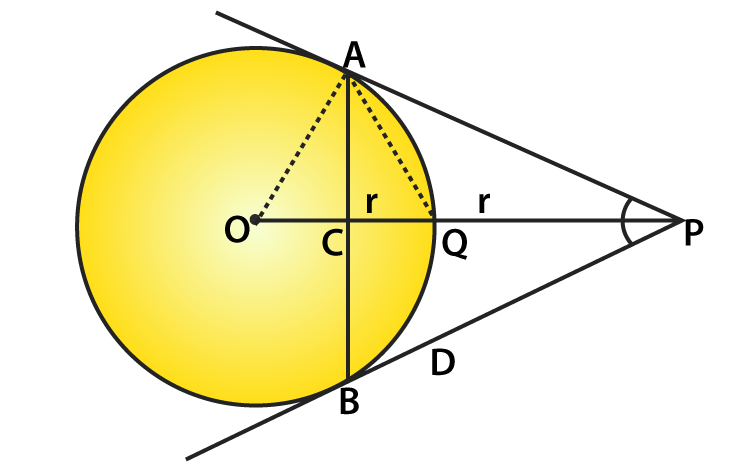
17. From a point P, two tangents PA and PB are drawn to a circle with centre O. If OP = diameter of the circle, show that ∆APB is equilateral.
Solution:
Given: From a point P outside the circle with centre O, PA and PB are the tangents to the circle such that OP is diameter.
And, AB is joined.
Required to prove: APB is an equilateral triangle
Construction: Join OP, AQ, OA
Proof:
We know that, OP = 2r
⇒ OQ + QP = 2r
⇒ OQ = QP = r
Now in right ∆OAP,
OP is its hypotenuse and Q is its mid-point
Then, OA = AQ = OQ
(mid-point of hypotenuse of a right triangle is equidistances from its vertices)
Thus, ∆OAQ is equilateral triangle. So, ∠AOQ = 60°
Now in right ∆OAP,
∠APO = 90° – 60° = 30°
⇒ ∠APB = 2 ∠APO = 2 x 30° = 60°
But PA = PB (Tangents from P to the circle)
⇒ ∠PAB = ∠PBA = 60°
Hence ∆APB is an equilateral triangle.
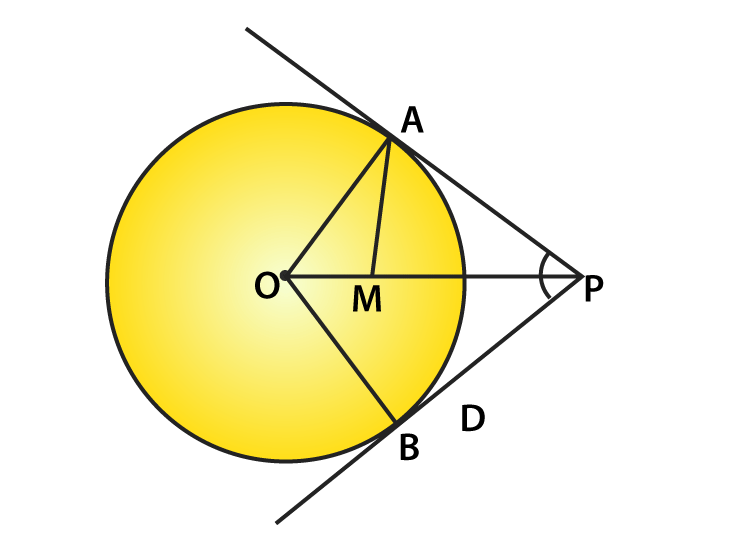
18. Two tangents segments PA and PB are drawn to a circle with centre O such that ∠APB = 120°. Prove that OP = 2 AP.
Solution:
Given: From a point P. Outside the circle with centre O, PA and PB are tangents drawn and ∠APB = 120°
And, OP is joined.
Required to prove: OP = 2 AP
Construction: Take mid-point M of OP and join AM, join also OA and OB.
Proof:
In right ∆OAP,
∠OPA = 1/2∠APB = 1/2 (120°) = 60°
∠AOP = 90° – 60° = 30° [Angle sum property]
M is mid-point of hypotenuse OP of ∆OAP [from construction]
So, MO = MA = MP
∠OAM = ∠AOM = 30° and ∠PAM = 90° – 30° = 60°
Thus, ∆AMP is an equilateral triangle
MA = MP = AP
But, M is mid-point of OP
So,
OP = 2 MP = 2 AP
– Hence proved.
19. If ∆ABC is isosceles with AB = AC and C (0, r) is the incircle of the ∆ABC touching BC at L. Prove that L bisects BC.
Solution:
Given: In ∆ABC, AB = AC and a circle with centre O and radius r touches the side BC of ∆ABC at L.
Required to prove : L is mid-point of BC.
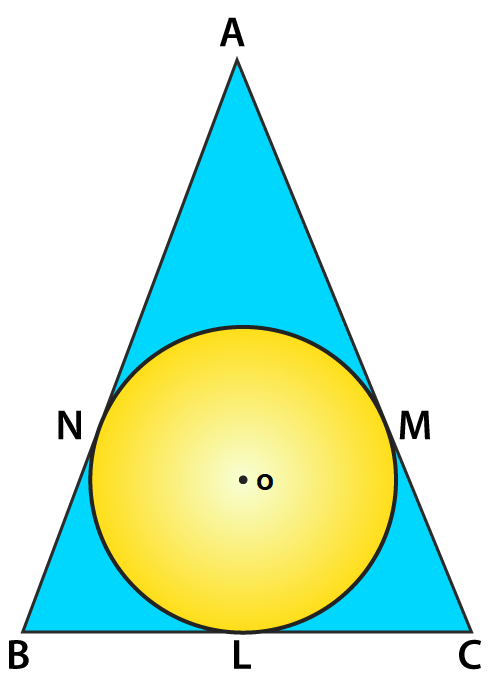
Proof :
AM and AN are the tangents to the circle from A.
So, AM = AN
But AB = AC (given)
AB – AN = AC – AM
⇒ BN = CM
Now BL and BN are the tangents from B
So, BL = BN
Similarly, CL and CM are tangents
CL = CM
But BN = CM (proved aboved)
So, BL = CL
Therefore, L is mid-point of BC.
20. AB is a diameter and AC is a chord of a circle with centre O such that ∠BAC = 30°. The tangent at C intersects AB at a point D. Prove that BC = BD. [NCERT Exemplar] Solution:
Required to prove: BC = BD
Join BC and OC.
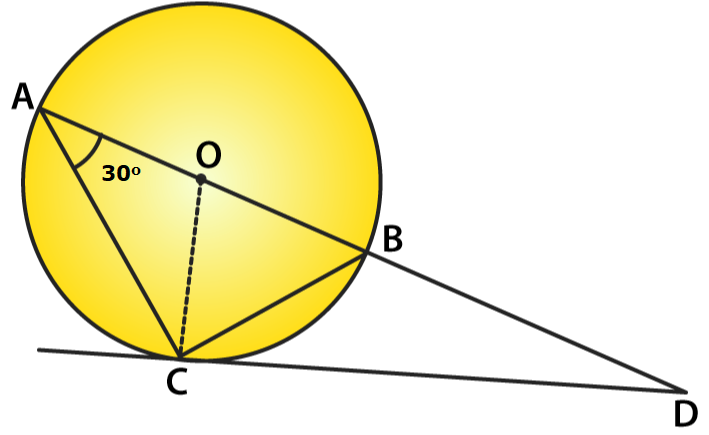
Given, ∠BAC = 30°
⇒ ∠BCD = 30°
[angle between tangent and chord is equal to angle made by chord in the alternate segment]
∠ACD = ∠ACO + ∠OCD
∠ACD = 30° + 90° = 120°
[OC ⊥ CD and OA = OC = radius ⇒ ∠OAC = ∠OCA = 30°]
In ∆ACD,
∠CAD + ∠ACD + ∠ADC = 180° [Angle sum property of a triangle]
⇒ 30° + 120° + ∠ADC = 180°
⇒ ∠ADC = 180° – (30° + 120°) = 30°
Now, in ∆BCD,
∠BCD = ∠BDC = 30°
⇒ BC = BD [As sides opposite to equal angles are equal]
- Hence Proved
21. In the figure, a circle touches all the four sides of a quadrilateral ABCD with AB = 6 cm, BC = 7 cm, and CD = 4 cm. Find AD.
Solution:
Given,
A circle touches the sides AB, BC, CD and DA of a quadrilateral ABCD at P, Q, R and S respectively.
AB = 6 cm, BC = 7 cm, CD = 4cm
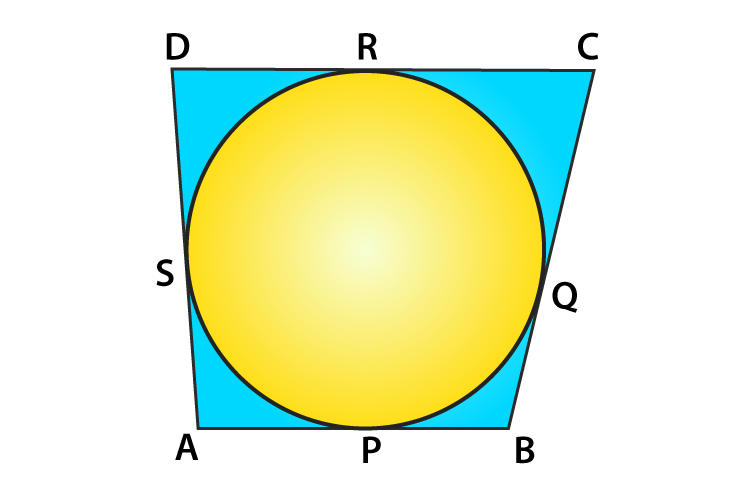
Let AD = x
As AP and AS are the tangents to the circle
AP = AS
Similarly,
BP = BQ
CQ = CR
and OR = DS
So, In ABCD
AB + CD = AD + BC (Property of a cyclic quadrilateral)
⇒ 6 + 4 = 7 + x
⇒ 10 = 7 + x
⇒ x = 10 – 7 = 3
Therefore, AD = 3 cm.
22. Prove that the perpendicular at the point contact to the tangent to a circle passes through the centre of the circle.
Solution:
Given: TS is a tangent to the circle with centre O at P, and OP is joined.
Required to prove: OP is perpendicular to TS which passes through the centre of the circle
Construction: Draw a line OR which intersect the circle at Q and meets the tangent TS at R
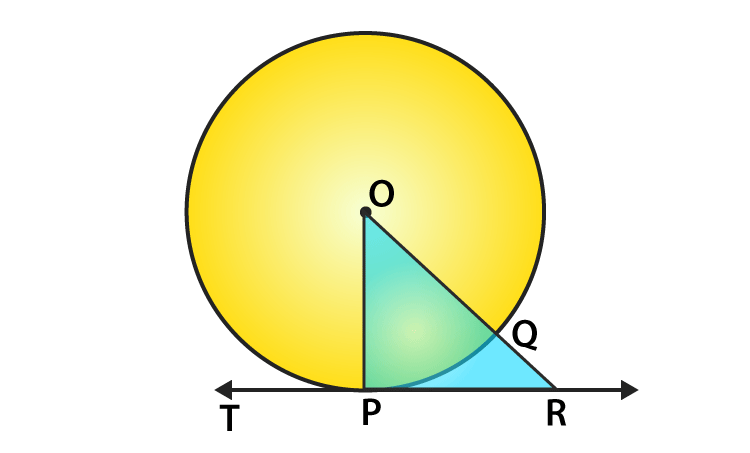
Proof:
OP = OQ (radii of the same circle)
And OQ < OR
⇒ OP < OR
similarly, we can prove that OP is less than all lines which can be drawn from O to TS.
OP is the shortest
OP is perpendicular to TS
Therefore, the perpendicular through P will pass through the centre of the circle
– Hence proved.
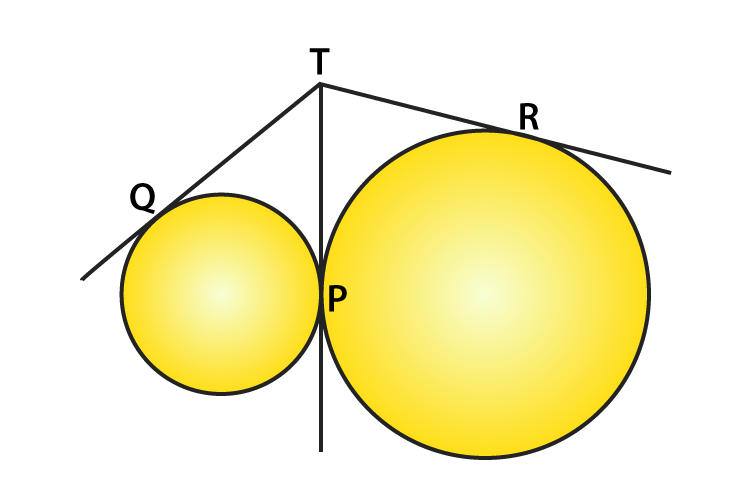
23. Two circles touch externally at a point P. From a point T on the tangent at P, tangents TQ and TR are drawn to the circles with points of contact Q and R respectively. Prove that TQ = TR.
Solution:
Given: Two circles with centres O and C touch each other externally at P. PT is its common tangent
From a point T: PT, TR and TQ are the tangents drawn to the circles.
Required to prove: TQ = TR
Proof:
From T, TR and TP are two tangents to the circle with centre O
So, TR = TP ….(i)
Similarly, from point T
TQ and TP are two tangents to the circle with centre C
TQ = TP ….(ii)
From (i) and (ii) ⇒
TQ = TR
– Hence proved.
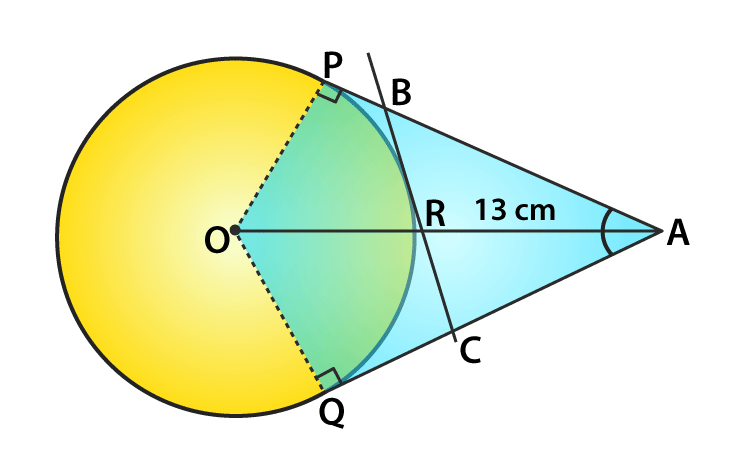
24. A is a point at a distance 13 cm from the centre O of a circle of radius 5 cm. AP and AQ are the tangents to the circle at P and Q. If a tangent BC is drawn at a point R lying on the minor arc PQ to intersect AP at B and AQ at C, find the perimeter of the ∆ABC.
Solution:
Given: Two tangents are drawn from an external point A to the circle with centre O. Tangent BC is drawn at a point R and radius of circle = 5 cm.
Required to find : Perimeter of ∆ABC.
Proof:
We know that,
∠OPA = 90°[Tangent at any point of a circle is perpendicular to the radius through the point of contact]
OA² = OP² + PA² [by Pythagoras Theorem]
(13)² = 5² + PA²
⇒ PA² = 144 = 12²
⇒ PA = 12 cm
Now, perimeter of ∆ABC = AB + BC + CA = (AB + BR) + (RC + CA)
= AB + BP + CQ + CA [BR = BP, RC = CQ tangents from internal point to a circle are equal]
= AP + AQ = 2AP = 2 x (12) = 24 cm
[AP = AQ tangent from internal point to a circle are equal]
Therefore, the perimeter of ∆ABC = 24 cm.

Comments
Post a Comment
Ask me anything here...